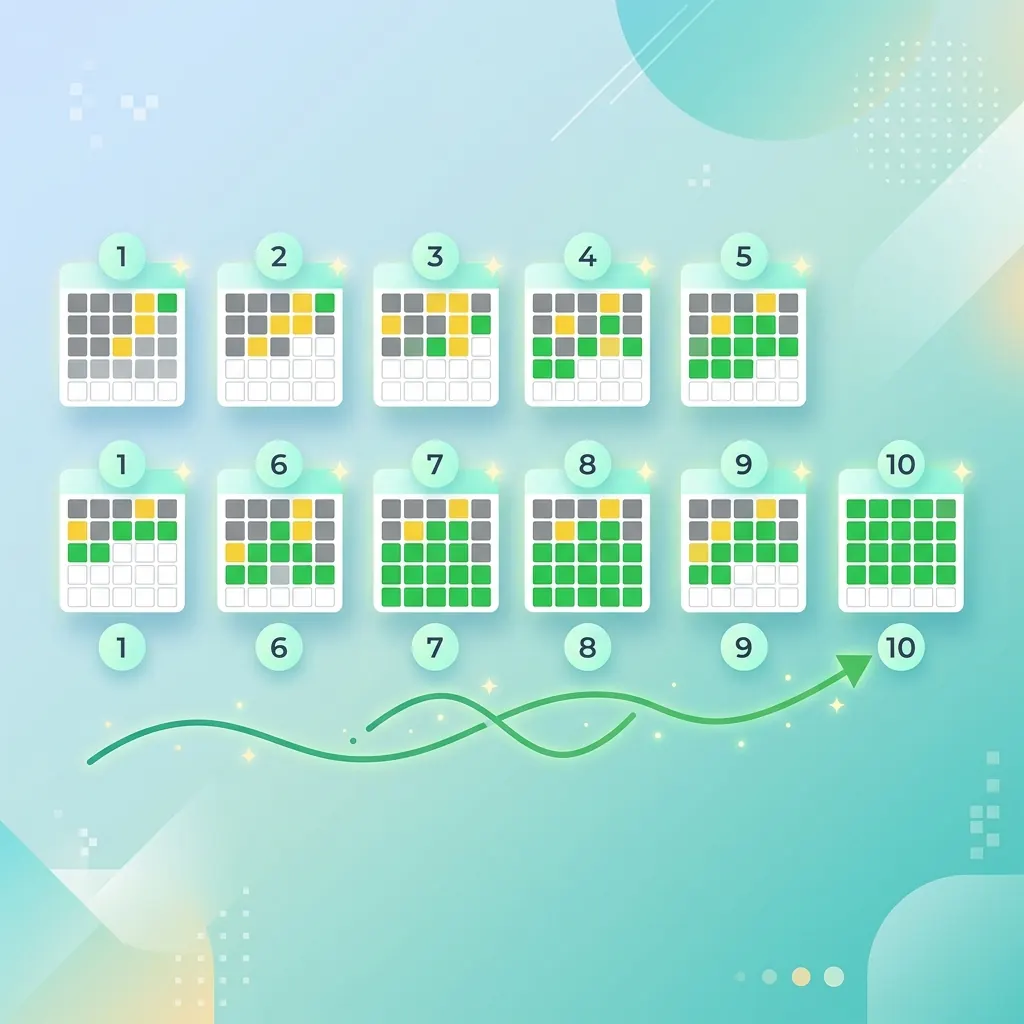
Everybody remembers their first Wordle game. Mine was terrible. I guessed QUEST, NYMPH, and FUZZY in my first three tries — burning through rare letters like someone who'd never seen an English word before. I failed spectacularly. But I also learned more in that one failed game than most players learn in ten successful ones.
If you're about to play your first Wordle (or you're five games in and struggling), this guide covers the exact mistakes you're probably making and the "aha!" moments that turn beginners into competent players almost overnight.
Games 1-3: The "Random Word" Phase
Common Mistake: Guessing Whatever Comes to Mind
Your first instinct is to just type — whatever word pops into your head first. HOUSE. PIZZA. MUSIC. These aren't terrible, but they're not strategic. You're essentially throwing darts blindfolded and hoping to hit something useful.
Quick Win: Pick One Good Starting Word and Use It Every Time
The single biggest improvement you can make — immediately, starting right now — is to commit to a strong opening word. Good starters contain common letters and no repeats:
- SLATE — covers S, L, A, T, E (all top-10 most common letters)
- CRANE — covers C, R, A, N, E
- STARE — covers S, T, A, R, E
Pick one. Memorize it. Use it for every single game until it's automatic. This one change will improve your average from ~5 guesses to ~4 guesses almost immediately.
Games 4-6: The "Tunnel Vision" Phase
Common Mistake: Fixating on One Possible Answer
After a few games, beginners start to recognize patterns. They'll see A and E confirmed and immediately lock onto one word — "It must be GRACE!" — and refuse to consider alternatives. This leads to disappointment when the word turns out to be BLAZE.
Quick Win: Stay Open Until Guess 3
For your first two guesses, focus on gathering information, not solving. Your goal is to test as many common letters as possible. By guess 3, you should have enough green and yellow tiles to make an educated attempt.
A practical approach:
- Guess 1: Your memorized starter (SLATE)
- Guess 2: A word that tests NEW letters, avoiding anything from guess 1 (try CORNY — tests C, O, R, N, Y)
- Guess 3: NOW use all your clues to guess the answer
This two-word opener strategy means you've tested 10 unique letters before making a real attempt. That's nearly half the alphabet!
Games 7-8: The "Gray Letter" Revelation
Common Mistake: Only Focusing on Green and Yellow
Beginners get excited about green tiles and strategize around yellow tiles. But they largely ignore gray tiles — which are actually the most powerful information in the game.
Quick Win: Gray Letters Are Elimination Gold
Every gray letter permanently eliminates that letter from ALL five positions. If SLATE gives you all gray, you've eliminated S, L, A, T, and E from the entire solution. That removes over 85% of common five-letter words from consideration.
Start paying attention to the keyboard at the bottom of the screen — it highlights which letters are gray, yellow, and green across all guesses. This visual tracker is your best friend. Before typing any guess, scan the keyboard first. Ask yourself: "Am I accidentally reusing a gray letter?"
Games 9-10: The "Why Didn't I Think of That?" Phase
Common Mistake: Ignoring Common Word Patterns
By game 9 or 10, you'll encounter your first answer that makes you slap your forehead. Words like KNACK, WHICH, or PLANT — common words that your brain refused to surface during the puzzle. This isn't a vocabulary problem. It's a retrieval problem.
Quick Win: Learn the Top 5 Ending Patterns
Memorizing these five common endings will unlock dozens of candidate words when you're stuck:
| Pattern | Example Words | % of Answers |
|---|---|---|
| _____E (ends in E) | CRANE, BLAZE, JUDGE, FRAME | ~18% |
| _____Y (ends in Y) | HAPPY, EARLY, DUSTY, FUNNY | ~15% |
| _____T (ends in T) | BOOST, FEAST, LIGHT, SMART | ~11% |
| _____R (ends in R) | CIDER, FLOOR, LAYER, OUTER | ~9% |
| _____D (ends in D) | GREED, PLAID, SOUND, MIXED | ~8% |
Together, these five endings account for over 60% of all Wordle answers. When you're stuck, mentally run through each pattern and your brain will often surface the answer.
5 Universal Lessons from Your First 10 Games
- Slow is fast. Taking 20 seconds to think between guesses saves more time than rushing and wasting guesses.
- Common letters first, always. Save the exotic letters (Z, X, Q, J, K) for when all common options are exhausted.
- Trust the process over intuition. If your gut says "JAZZY" but the data says test E and R first, trust the data.
- Failure teaches more than success. The games you lose stick with you. Analyze them: what word were you stuck on? Why didn't you think of it?
- Practice accelerates everything. Unlimited Wordle mode lets you condense weeks of daily play into one afternoon of concentrated practice.
What Happens After 10 Games
Around game 10-15, something clicks. You stop consciously thinking about strategy and start feeling the patterns. Your fingers know the starting word before your brain types it. Your eye automatically scans for common endings. Gray tile elimination becomes instant.
This is the transition from beginner to intermediate player. You're no longer learning the rules — you're developing instincts. And Those instincts compound: by game 50, you'll be averaging 3-4 guesses and wondering why you ever found the game difficult.
Fast-Track Your First 10 Games
Play unlimited practice rounds — no daily limits, no pressure.
Start Practicing Free