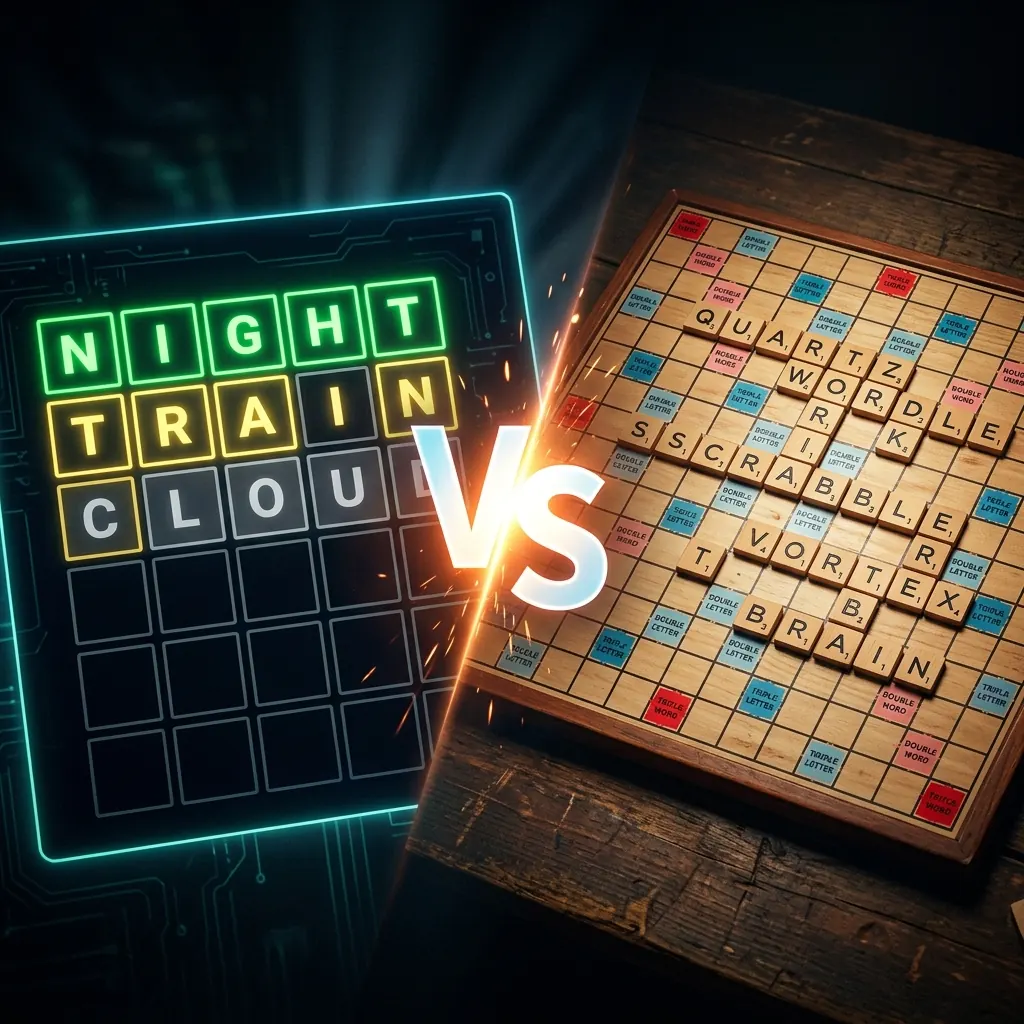
My mother is a Scrabble champion. Literally — she's won two regional tournaments and has a rating that puts her in the top 5% nationally. She also struggles with Wordle. Regularly uses 5 guesses. Occasionally fails entirely.
Meanwhile, I crush Wordle (3.2 average, 400+ day streak) but get demolished by my mother in Scrabble every single holiday. How is that possible? We're both "word people." We both have large vocabularies. Yet our performance in each game is almost inversely correlated.
The answer reveals something fascinating about how these two iconic word games test fundamentally different cognitive skills.
Core Mechanics: Completely Different Games
| Feature | Wordle | Scrabble |
|---|---|---|
| Goal | Deduce a hidden word | Score maximum points from available letters |
| Word length | Always 5 letters | Any length (2-15+) |
| Core skill | Logical deduction | Vocabulary breadth + spatial planning |
| Randomness | Fixed puzzle, same for everyone | Random tile draw, highly variable |
| Opponent | The puzzle itself | Other players |
| Time per game | 2-5 minutes | 30-90 minutes |
| Vocabulary needed | Common 5-letter words (~2,300) | Every valid English word (~280,000) |
Which Is Actually Harder?
This question doesn't have a clean answer, because "harder" depends on which cognitive skills you're measuring. Let me break it down by skill type:
Vocabulary Demand: Scrabble Wins (By a Landslide)
Competitive Scrabble players memorize obscure two-letter words (QI, XI, ZA), learn unusual hooks (adding letters to existing words), and study word lists organized by tile combinations. The competitive Scrabble dictionary contains over 280,000 valid words — more than 100x Wordle's answer list.
Wordle uses common, recognizable five-letter words. If you can read a newspaper, you have sufficient vocabulary for Wordle. No memorization required.
Verdict: Scrabble demands 100x more vocabulary knowledge.
Logical Deduction: Wordle Wins
Wordle is fundamentally a logic puzzle. Each guess provides constraints, and you must deduce the answer through systematic elimination. It's closer to Sudoku than to Scrabble in terms of cognitive process.
Scrabble involves optimization (finding the highest-scoring word from available tiles) rather than deduction. You're never "solving" for an unknown — you're building from known resources.
Verdict: Wordle requires stronger analytical thinking.
Strategic Depth: Scrabble Wins
Scrabble has layers of strategy that Wordle simply doesn't have. Beyond finding words, you must manage board position (blocking premium squares), plan tile exchanges, balance offense and defense, track remaining tiles, and adapt to your opponent's strategy.
Wordle strategy, while meaningful, is simpler: pick good starting words, use elimination, and make smart guesses. There's no opponent to read, no board state to manage, no resource economy.
Verdict: Scrabble has significantly more strategic depth.
Accessibility: Wordle Wins
Anyone can play Wordle immediately. The learning curve is approximately 30 seconds. Scrabble requires understanding tile values, premium squares, word validity rules, and challenge mechanics before you can play competently.
Verdict: Wordle is dramatically more accessible.
Which Makes You Smarter?
Both games exercise your brain, but in different areas:
| Cognitive Skill | Wordle | Scrabble |
|---|---|---|
| Working memory | ⭐⭐⭐⭐⭐ | ⭐⭐⭐ |
| Vocabulary expansion | ⭐⭐⭐ | ⭐⭐⭐⭐⭐ |
| Pattern recognition | ⭐⭐⭐⭐⭐ | ⭐⭐⭐ |
| Strategic planning | ⭐⭐ | ⭐⭐⭐⭐⭐ |
| Spatial reasoning | ⭐ | ⭐⭐⭐⭐ |
| Processing speed | ⭐⭐⭐⭐ | ⭐⭐ |
| Social cognition | ⭐ (solo) | ⭐⭐⭐⭐ (opponent reading) |
The honest answer: they complement each other. Wordle exercises fast, focused deductive thinking. Scrabble exercises broad vocabulary access, strategic planning, and spatial reasoning. Playing both gives your brain the most complete workout.
The Social Experience
Scrabble is inherently social — you sit across from someone, negotiate challenges, celebrate big plays, and groan at your tile draws. It creates shared memories over extended play sessions.
Wordle's social layer is different but equally powerful. The shared daily puzzle creates a universal conversation point. Texting your result grid to friends. The morning office chat about strategy. It's social connection in micro-doses rather than extended sessions.
WordlyPlay's battle mode bridges this gap — live head-to-head word competition with the speed and accessibility of Wordle but the competitive tension of Scrabble.
The Verdict
Scrabble is the "harder" game by most objective measures — deeper strategy, larger vocabulary demands, more complex mechanics. It rewards years of dedicated study.
Wordle is the "sharper" game — it targets specific cognitive skills with surgical precision and respects your time. Five minutes, one puzzle, maximum mental engagement per second of play.
They're not competitors. They're complements.
My mother still beats me at Scrabble. I still solve Wordle faster than she does. And every holiday, we play both — because the best word game is whatever one brings your brain to life.
Try the Modern Word Game Experience
Wordle unlimited — fast, focused, and free. Perfect complement to longer board game sessions.
Play Wordle Free