If you want to get really good at Wordle, you need to stop thinking about letters in general and start thinking about letters in specific positions. Knowing that E is the most common letter overall is helpful— but knowing that S is the most common first letter while E dominates last position is a game-changer.
I analyzed the complete Wordle answer list to map out exactly which letters appear where, and more importantly, what this means for your strategy.
Overall Letter Frequency in Wordle
First, the big picture. These are the 10 most common letters across all Wordle answers:
| Rank | Letter | Appearances | % of Answers |
|---|---|---|---|
| 1 | E | 1,230 | 53.1% |
| 2 | A | 975 | 42.1% |
| 3 | R | 897 | 38.7% |
| 4 | O | 753 | 32.5% |
| 5 | T | 729 | 31.5% |
| 6 | L | 716 | 30.9% |
| 7 | I | 670 | 28.9% |
| 8 | S | 668 | 28.8% |
| 9 | N | 573 | 24.7% |
| 10 | C | 475 | 20.5% |
Position 1 (First Letter)
The most common starting letters tell you a lot about English word structure:
Top 5: S (365), C (198), B (173), T (149), P (141)
S absolutely dominates position 1. If you need to guess a starting consonant, S should almost always be your first instinct. This is why words like SLATE and STARE are such effective openers — they test S in position 1 where it's most likely to appear.
Position 2 (Second Letter)
Top 5: A (304), O (279), R (267), E (241), I (201)
Vowels dominate position 2. This makes intuitive sense — most English words follow a consonant-vowel pattern at the start (STARE, CRANE, GROUP). If your starter reveals no vowels in position 2, you've already eliminated many common patterns.
Position 3 (Middle Letter)
Top 5: A (306), I (266), O (243), E (177), U (165)
Again, vowels. The middle position is the "heart" of most five-letter words and it's almost always a vowel. Strategy implication: when you know the middle letter is a consonant (like in LYMPH), you're dealing with an uncommon word pattern.
Position 4 (Fourth Letter)
Top 5: E (318), N (182), S (171), A (162), L (162)
E re-emerges as the dominant letter in position 4. Many common word patterns end with E in the second-to-last spot: _A_ER, _I_ER, _O_EN, _A_ER. This is also where you see pattern consonants like N and S frequently.
Position 5 (Last Letter)
Top 5: E (422), Y (364), T (253), R (212), L (155)
E is the king of the final position, appearing in 18.2% of all answers at position 5. Y is surprisingly close — words ending in -LY, -RY, -NY are very common. Together, E and Y account for nearly 34% of all final letters.
What This Means for Your Strategy
Build Your Starting Word Around Position Data
The ideal starter has each letter in its most statistically likely position:
- Position 1: S or C
- Position 2: A, O, or R
- Position 3: A, I, or O
- Position 4: E, N, or S
- Position 5: E, Y, or T
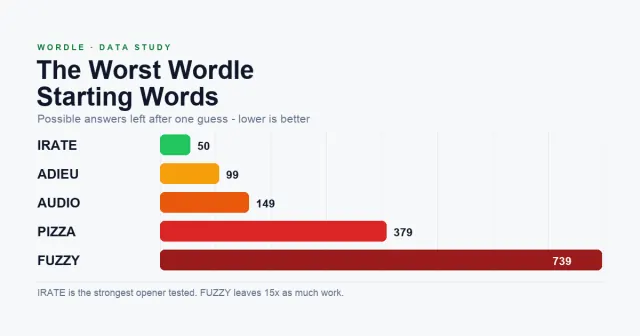
This is why SAREE and SOAPY score well in positional analysis — their letters are where they're most likely to match.
The "Rarest Position" Insight
The most valuable information comes from confirming rare position-letter combinations. If you find that J is in position 3, you've eliminated almost everything. Seek out the unusual — it narrows faster.
Putting It All Together
Here's a practical approach using frequency data:
- Guess 1: Use SLATE to test S(1), L(2), A(3), T(4), E(5) — each letter in a high-frequency position
- Guess 2: Based on results, prioritize testing letters in their statistically most likely positions
- Guess 3+: Use elimination to narrow down. The frequency data tells you which remaining candidates are most probable
This data-driven approach won't guarantee solving every puzzle in 2 guesses. But it will consistently give you an edge — the kind of edge that turns a 4-guess average into a 3.5-guess average over time.
Put Your Data Knowledge to Work
Practice with unlimited games and track your improvement over time.
Play Wordle Unlimited