There are exactly three official rules in Wordle. Three. Yet somehow, the game generates more confusion, debate, and "wait, I didn't know that!" moments than games with 40-page rulebooks. That's because the simplicity hides surprising depth.
I've been writing about Wordle since it went viral, and the questions keep coming: "Can you use the same letter twice?" "Does the yellow still count if there's also a green?" "What happens if there are two of the same letter?" These aren't beginner questions — seasoned players get tripped up by edge cases all the time.
This guide covers every rule, official and unofficial, written and unwritten. Bookmark it. You'll need it.
The 3 Official Rules
Wordle's elegance comes from its simplicity. The entire game can be explained in three sentences:
- Guess a valid five-letter word. Each guess must be a real English word recognized by Wordle's dictionary.
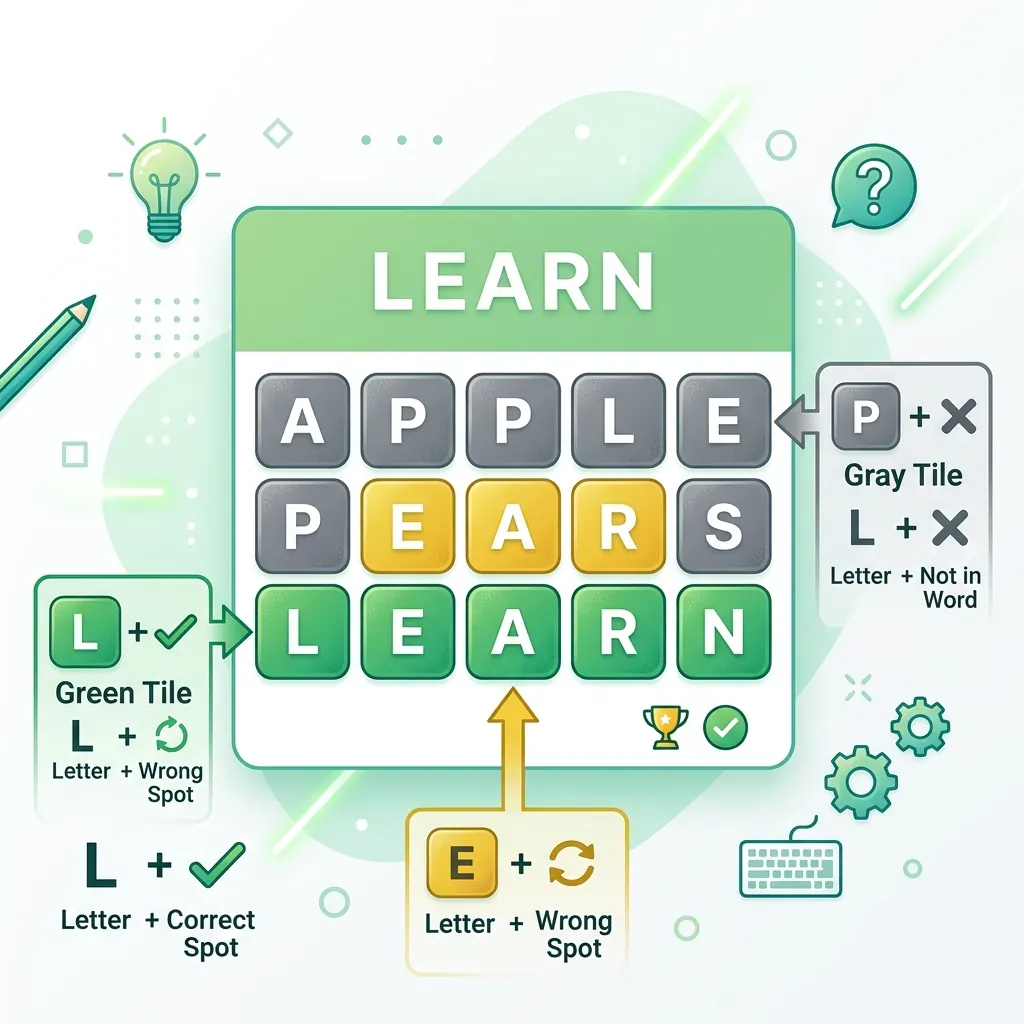
- Read the color feedback. After each guess, every letter turns green (correct position), yellow (wrong position), or gray (not in the word).
- Solve within six guesses. You have six attempts to identify the target word.
That's it. No points, no timer (in the standard version), no bonus rounds. Just you, five letters, and six tries.
The Color System: Deeper Than You Think
Most players understand the basics — green means right letter in right place, yellow means right letter in wrong place, gray means the letter isn't in the word. But the edge cases are where confusion lives.
The Double-Letter Rule
This is the single most confusing aspect of Wordle. Here's how it works:
If the target word is SPEED and you guess GEESE:
- G → Gray (not in the word)
- E (position 2) → Yellow (E is in the word, but not here — position 4 has the first E)
- E (position 3) → Yellow (the second E exists at position 5)
- S → Yellow (S is in the word, but at position 1, not position 4)
- E (position 5) → Green (correct! E is at position 5 in SPEED)
The critical insight: Wordle tracks each instance of a letter separately. SPEED has two E's, so up to two E's in your guess will get colored feedback. If you guessed a word with three E's, the third would turn gray because SPEED only has two.
Green Always Takes Priority
When a letter appears multiple times in your guess, green matches are assigned first. Example: if the answer is ROBOT and you guess ROTOR:
- R (pos 1) → Green ✅
- O (pos 2) → Green ✅
- T (pos 3) → Yellow (T exists, but at position 4)
- O (pos 4) → Yellow (O exists at position 4 in ROBOT)
- R (pos 5) → Gray (only one R in ROBOT, and it's already matched at position 1)
What Counts as a Valid Guess?
Not every five-letter combination works. Wordle has two word lists:
| List | Size | Purpose |
|---|---|---|
| Answer list | ~2,300 words | Words that can be the daily answer |
| Valid guess list | ~10,000 words | All words you can type as guesses |
The answer list is curated — it excludes obscure words, slang, and anything most people wouldn't recognize. The guess list is much broader, letting you use uncommon words as strategic guesses even if they'd never be the answer.
Words that are NOT valid:
- Proper nouns (PARIS, JAMES)
- Abbreviations (ASAP, RADAR — wait, RADAR is valid!)
- Non-English words
- Random letter combinations (XYZAB)
- Words not in Wordle's specific dictionary
Hard Mode Rules
Hard Mode adds two constraints on top of the base rules:
- Green lock-in: Any letter that turns green MUST remain in that position for all subsequent guesses.
- Yellow inclusion: Any letter that turns yellow MUST be included somewhere in all subsequent guesses.
These rules prevent "throwaway" guesses — words designed purely for information gathering. In Hard Mode, every guess must be a genuine attempt at the answer that incorporates everything you've learned so far.
What Hard Mode does NOT change:
- Same six-guess limit
- Same word list
- Same color system
- No timer or scoring changes
The Unwritten Rules
These aren't enforced by the game, but the Wordle community takes them seriously:
1. No Spoilers Before Midnight
Everyone plays the same daily word. Sharing the answer — or even strong hints — before midnight is considered a cardinal sin. If you share your grid, use the spoiler-free emoji format only.
2. First Guess Should Test Common Letters
While there's no rule against starting with JAZZY or XEROX, the community consensus is that "wasting" your opener on rare letters is poor form — at least in competitive or shared contexts. Save the quirky starters for practice mode.
3. No External Solver Tools
Using a Wordle solver or dictionary while playing is widely considered cheating. If you need to verify that a word exists before guessing, that's a gray area — but running an algorithm to find the optimal next guess is firmly in "cheating" territory.
4. Streak Integrity
If you miss a day (and your streak resets), don't manually set the date back on your device to preserve it. Other players will know. They always know.
Daily Puzzle Timing
The daily Wordle resets at midnight local time. This means:
- The puzzle changes at 12:00 AM in YOUR time zone
- People in different time zones get the new word at different real-world times
- If you haven't solved by midnight, the puzzle expires and your streak breaks
- You can't go back and play previous days' puzzles on the official NYT version
For practice without the daily limit, unlimited Wordle generates fresh puzzles on demand — no waiting, no deadlines.
5 Common Rule Misconceptions
| Misconception | Reality |
|---|---|
| "Gray means the letter isn't in the word at all" | Only if it appeared once. With doubles, gray means there are no MORE of that letter. |
| "You can't reuse gray letters" | You CAN guess gray letters again — it's just usually unwise. |
| "Hard Mode makes different words appear" | Same word list. Only your guessing strategy is constrained. |
| "Wordle gets harder over time" | No difficulty progression. Each puzzle is independent. |
| "There's a penalty for using all 6 guesses" | No penalty. A 6-guess solve is still a win. |
Frequently Asked Questions
Yes. Words like SPEED, TEETH, ROBOT, and HUMMUS (if it were 5 letters) are valid. Double and even triple letters can appear in Wordle answers.
The core rules are identical across all versions. However, different platforms may use different word lists and offer additional features like unlimited play, timer modes, or multiplayer battles.
After six failed guesses, the correct answer is revealed. Your streak resets to zero, but you can start building a new one the next day. In unlimited mode, you simply start a new puzzle immediately.
Put These Rules to the Test
Play unlimited Wordle games to master every rule and edge case.
Play Wordle Free