I coach competitive Wordle players. Not professionally — nobody pays me for this — but I've helped about forty friends and family members improve their games over the past two years. And you know what? Nearly every struggling player makes the same seven mistakes.
The good news: every one of these mistakes has a simple fix. Most players see measurable improvement within a week of addressing even two or three of them.
Mistake #1: Changing Your Starting Word Every Day
"I like to mix it up. Keeps things fresh." I hear this constantly. And it's one of the biggest performance killers in Wordle.
When you change your starting word daily, you lose two advantages: muscle memory (you have to think about your opener instead of analyzing results) and consistency (you can't develop intuition for how results flow from a specific starter).
The Fix: Pick ONE starting word with common letters — SLATE, CRANE, STARE — and use it for every single game for at least 30 days. Your brain will start processing the color results faster because it recognizes the patterns from your consistent opener.
Mistake #2: Reusing Gray Letters
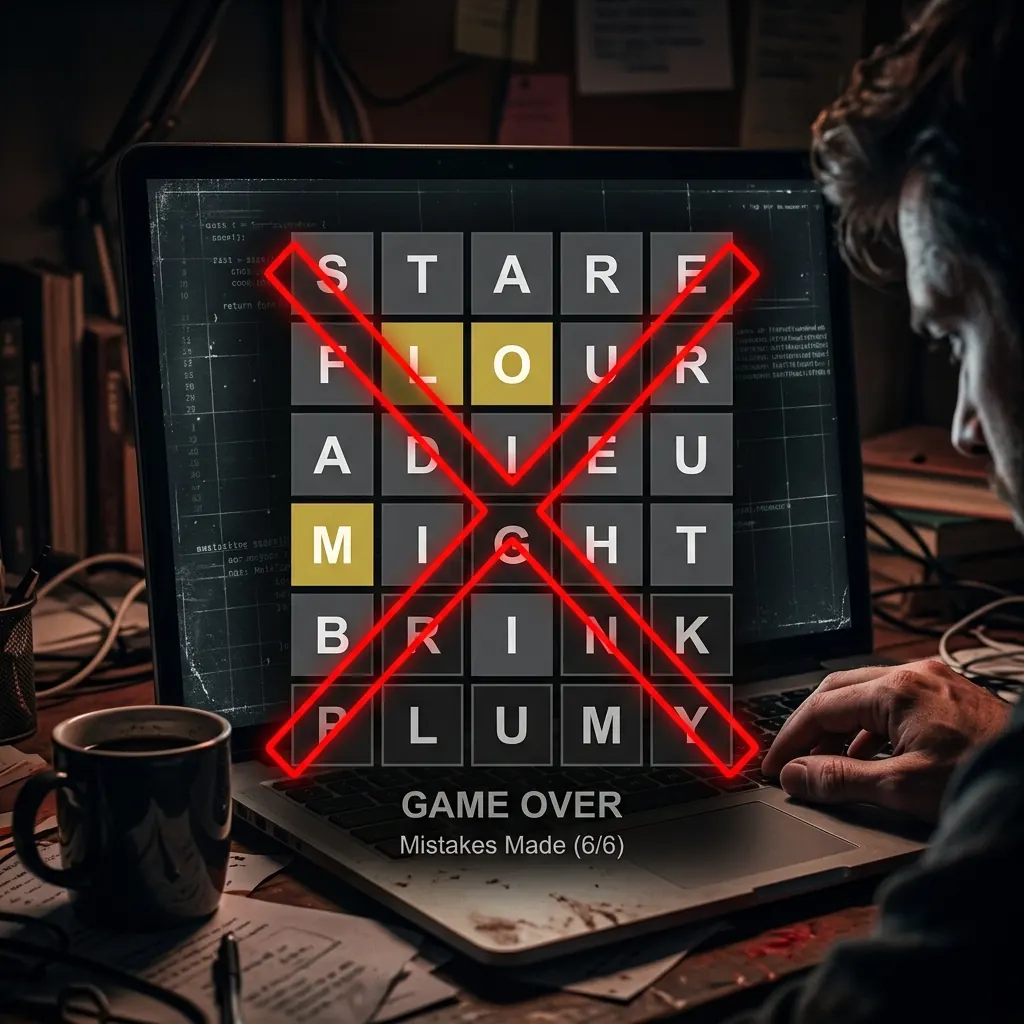
This sounds obvious, and yet I watch players do it constantly. The letter T turned gray on guess 1, and there it is again in guess 3. Sometimes even in the same position.
The keyboard tracker at the bottom of the screen exists specifically to prevent this. Most players glance at it occasionally. You should check it before every single guess.
The Fix: Before typing any guess, scan the keyboard. Mentally recite "no S, no L, no T" (or whatever's gray). This takes 3 seconds and prevents wasted guesses entirely.
Mistake #3: Ignoring Letter Position Data
Yellow tells you two things: the letter IS in the word, and it's NOT in this position. Most players only process the first part. They know E is in the word, but they don't track that E is specifically NOT in position 3.
This matters because players often put yellow letters right back in positions they've already been eliminated from. That's doubly wasteful — you're not learning anything new AND you might miss the correct position.
The Fix: When you see yellow, mentally note: "E yes, but not position 3." On your next guess, consciously place that letter in a DIFFERENT position.
Mistake #4: Going for the Solve Too Early
After one guess with a green and a yellow, many players think "I bet I know what it is!" and attempt the answer on guess 2. Sometimes they're right. Often they're wrong — and now they've wasted a guess on a half-informed gamble.
Unless you have 3+ greens after guess 1 (rare but it happens), guess 2 should almost always be an information-gathering guess that tests new letters.
The Fix: Adopt the "two-word opener" strategy. Use guesses 1 and 2 to test 10 unique letters before attempting to solve on guess 3. This approach feels slower but consistently produces better results.
Mistake #5: Never Considering Double Letters
About 15% of Wordle answers contain at least one repeated letter. STEEL, HAPPY, TEETH, VIVID — doubles are more common than most players realize. But the default assumption is always "five unique letters."
This assumption works for 85% of puzzles. For the other 15%, it creates a blind spot that leads to guess 5 or 6 failures.
The Fix: If you've confirmed 3-4 unique letters by guess 3 and nothing fits, immediately consider doubles. Ask: "Could any of my confirmed letters appear twice?" This single question resolves most late-game stuck moments.
Mistake #6: Playing Too Fast
Speed is for battles. For the daily puzzle and practice, speed actively hurts your performance. Fast players skip their analysis, rely on gut instinct, and make avoidable errors.
The average Wordle puzzle takes 2-4 minutes to solve well. Many players attempt to solve in under 60 seconds. The 2-3 extra minutes of thinking typically save 1-2 guesses.
The Fix: After each guess, pause for at least 5 seconds before typing the next one. Use that time to review the keyboard, consider your constraints, and evaluate your options. This one habit alone can improve your average by 0.3-0.5 guesses.
Mistake #7: Not Practicing Between Daily Puzzles
Playing one puzzle per day improves your skills very slowly. You encounter one word, one pattern, one solving experience per 24 hours. Over a month, that's 30 data points for your brain to learn from.
Players who supplement the daily puzzle with unlimited practice games encounter 10-20x more patterns. Their brains build larger pattern libraries, faster letter-frequency intuition, and more resilient solving strategies.
The Fix: Play 3-5 practice games per day in addition to the daily puzzle. Think of it as practice vs. performance — athletes don't show up to the game without training all week.
Quick Self-Assessment
| Mistake | Your Status | Impact |
|---|---|---|
| Changing starting word | ☐ Guilty / ☐ Not me | +0.3 avg guesses |
| Reusing gray letters | ☐ Guilty / ☐ Not me | +0.5 avg guesses |
| Ignoring positions | ☐ Guilty / ☐ Not me | +0.3 avg guesses |
| Solving too early | ☐ Guilty / ☐ Not me | +0.4 avg guesses |
| No double letters | ☐ Guilty / ☐ Not me | +0.2 avg guesses |
| Playing too fast | ☐ Guilty / ☐ Not me | +0.3 avg guesses |
| No practice | ☐ Guilty / ☐ Not me | +0.5 avg guesses |
If you checked 4+ boxes, fixing just those habits could improve your average by a full guess or more.