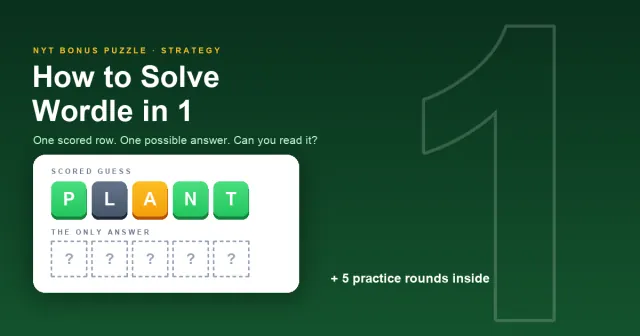
Watch a top Wordle player solve a puzzle and you'll notice something strange: they don't look like they're guessing. There's no chin-scratching, no "hmm, maybe..." hesitation. They type, they read, they type, they solve. Three guesses. Elapsed time: 40 seconds.
What you're watching isn't genius or luck. It's systematic elimination — a framework that treats each Wordle guess not as an attempt to solve, but as a tool to divide the remaining possibilities in half (or less). Here's exactly how it works.
The Core Principle: Divide and Conquer
Imagine you're playing a number-guessing game where someone has picked a number between 1 and 100. Would you guess randomly — 37? 84? 12? Or would you start with 50 to cut the range in half?
The elimination technique applies this same principle to Wordle. Each guess should maximally divide the remaining candidate words. You're not trying to guess the answer — you're trying to learn the most information possible per guess.
The math is compelling:
| After Guess | Random Strategy | Elimination Strategy |
|---|---|---|
| Start | ~2,315 candidates | ~2,315 candidates |
| Guess 1 | ~800 remaining | ~71 remaining |
| Guess 2 | ~350 remaining | ~5 remaining |
| Guess 3 | ~120 remaining | 1 (solved!) ✅ |
| Guess 4 | ~40 remaining | — |
| Guess 5 | ~10 remaining | — |
A random guesser typically needs 5 attempts. A systematic eliminator needs 3. That's the difference between a casual player and a top performer.
The Three Phases of Elimination
Phase 1: The Scout (Guess 1)
Your first guess has one job: test the maximum number of common letters. You're not trying to solve — you're scouting.
The ideal scout word has:
- No repeated letters (waste of a testing slot)
- High-frequency letters (E, A, R, O, T, L, I, S, N)
- Letters in their most common positions (S in position 1, E in position 5)
After the scout, you'll have 5 data points: each letter is definitively green, yellow, or gray. That's 5 facts about the answer — enough to eliminate the vast majority of candidates.
Phase 2: The Probe (Guess 2)
This is where amateurs and pros diverge completely. An amateur sees a yellow E and a green A and thinks "it must be..." A pro looks at what's still unknown and picks a word that tests those unknowns.
The probe should:
- Test letters NOT used in guess 1 (if playing normal mode)
- Cover the remaining common consonants and vowels you haven't tested
- Place known yellow letters in new positions (to narrow their location)
After a good scout + probe, you've tested 8-10 unique letters. With only 26 letters in the alphabet, that's nearly 40% coverage. The number of remaining candidates typically drops to single digits.
Phase 3: The Strike (Guess 3)
Now — and only now — you try to solve. With 8-10 letters tested and position data from greens and yellows, there are usually 1-5 candidates remaining. Your brain navigates these naturally through pattern recognition.
If there's only one candidate: type it confidently. You know it's right.
If there are 2-3 candidates: pick the one with the most common remaining letter.
If there are 5+ candidates: you may need guess 3 as another probe (rare with good scout/probe selections).
Worked Example: Full Elimination
Let's walk through a real solve using pure elimination thinking:
Target word (unknown to us): CRAFT
Guess 1: SLATE
- S → ⬜ Gray (not in word)
- L → ⬜ Gray (not in word)
- A → 🟨 Yellow (in word, not position 3)
- T → 🟨 Yellow (in word, not position 4)
- E → ⬜ Gray (not in word)
What we know after guess 1:
- ✅ A is in the word (not position 3)
- ✅ T is in the word (not position 4)
- ❌ S, L, E are eliminated
- ❓ Still unknown: all consonants except S and L; vowels O, I, U
Guess 2: CORNY (tests C, O, R, N, Y — all new letters)
- C → 🟩 Green! (position 1 ✅)
- O → ⬜ Gray
- R → 🟨 Yellow (in word, not position 3)
- N → ⬜ Gray
- Y → ⬜ Gray
What we know after guess 2:
- ✅ C is position 1
- ✅ A, T, R are in the word
- ❌ S, L, E, O, N, Y are eliminated
- Pattern: C _ _ _ _ with A, R, T somewhere in positions 2-5
- A ≠ position 3, T ≠ position 4, R ≠ position 3
Analysis: C_ _ _ _ needs to contain R, A, T. Let me think... C-R-A-?-T → CRAFT! That uses all three letters and fills the pattern beautifully.
Guess 3: CRAFT → 🟩🟩🟩🟩🟩 Solved in 3!
Advanced Elimination Techniques
The Positional Lock Technique
When you have 2-3 yellow letters, try to "lock" them into green positions as quickly as possible. Each yellow-to-green conversion reduces candidates dramatically because you go from "this letter is somewhere" to "this letter is HERE."
The Common-Pattern Shortcut
After guess 2, instead of thinking about individual letters, think about word patterns. "_R_FT" is a recognizable pattern. "_OUND" is a recognizable pattern. Pattern recognition is faster than letter-by-letter construction.
The Constraint Counter
Count your constraints: each green is 1 constraint, each yellow is 0.5 constraints (known letter, unknown position), each gray is informational but doesn't constrain placement. When your constraint count reaches 3.5+, you're usually ready to solve.
Elimination Mistakes to Avoid
- Solving too early — Don't attempt the answer on guess 2 unless you have 3+ greens. Use guess 2 for more information.
- Repeating tested letters — In normal mode, your probe should use entirely new letters. Don't "waste" a slot confirming what you already know.
- Ignoring position data — A yellow in position 2 tells you where the letter ISN'T. Use this to narrow positions, not just confirm presence.
- Forgetting gray letters — The keyboard tracker exists for a reason. Check it before every guess.
Practice the Elimination Framework
The elimination technique becomes automatic with practice. Here's a structured approach:
- Week 1: Play 10 unlimited games daily. Before each guess, write down your reasoning.
- Week 2: Focus on guess 2 quality. After your scout, explicitly list what's unknown before choosing your probe.
- Week 3: Time yourself. Target under 60 seconds per solve while maintaining 3-4 guess accuracy.
Most players see a 0.5-1.0 guess improvement within two weeks of conscious elimination practice. The technique eventually becomes subconscious — you'll stop thinking about the framework and just do it.
Master Elimination with Practice
Unlimited games let you drill the technique risk-free.
Start Practicing