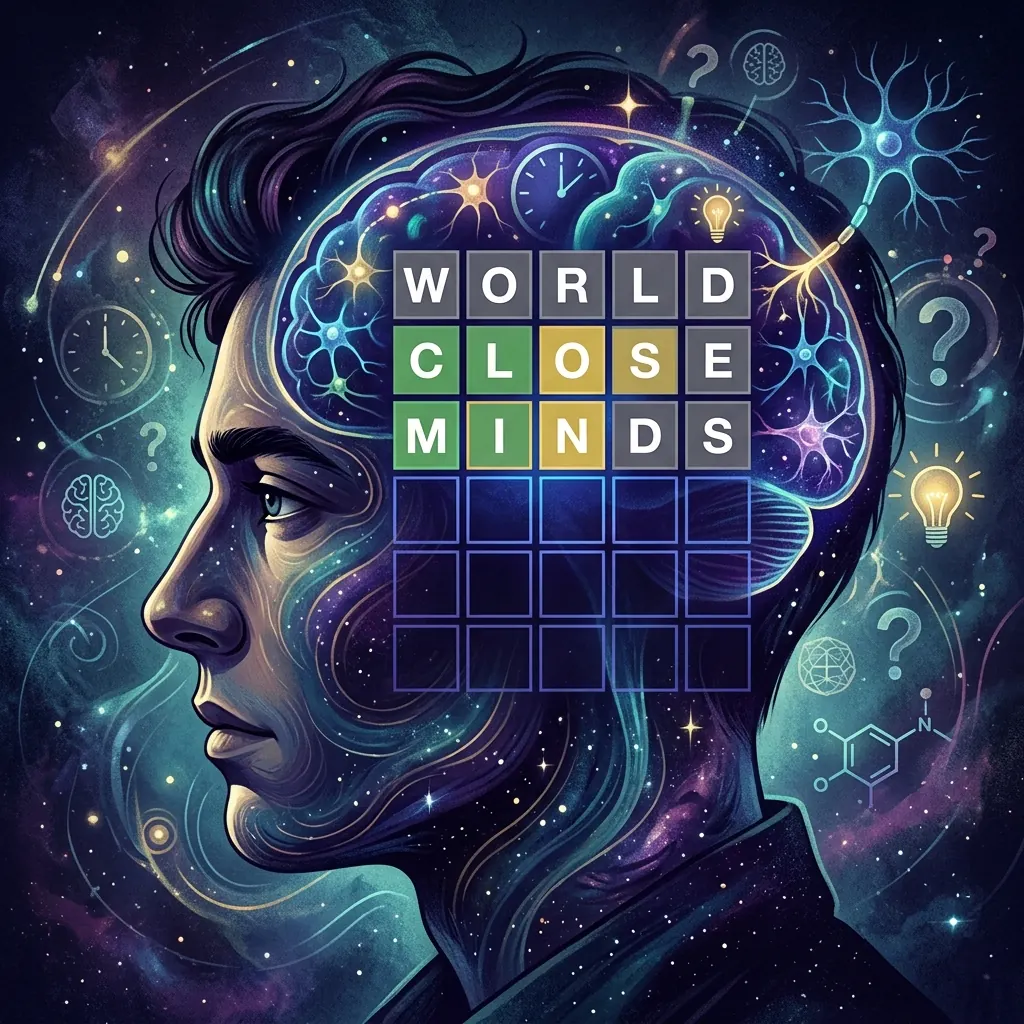
Josh Wardle called it "the croissant principle." When asked why Wordle only offers one puzzle per day, the game's creator compared it to a French bakery: you don't eat an entire tray of croissants. You eat one, enjoy it fully, and look forward to tomorrow's. That restraint — choosing to leave players wanting more rather than feeding them into exhaustion — turned Wordle into one of the most psychologically compelling games ever created.
As a behavioral scientist, I find Wordle endlessly fascinating. Not because of the word game mechanics (those are simple), but because nearly every design decision accidentally or deliberately triggers well-documented psychological principles. Let me walk you through them.
The Scarcity Effect
Humans value scarce things more than abundant ones. This is so well-established in psychology that it's practically a law. A cookie from the last pack tastes better than a cookie from a full pack. A limited-edition sneaker feels more desirable than an identical mass-produced one.
Wordle applies scarcity directly to gameplay: one puzzle per day, and when it's gone, it's gone. This creates three powerful effects:
- Anticipatory pleasure — Knowing tomorrow's puzzle is coming creates a low-level excitement throughout the day
- Enhanced savoring — Because you only get one shot, each guess feels more meaningful
- Loss aversion — Missing a day means genuinely losing something (the puzzle, your streak) — which feels worse than the equivalent gain
Compare this to mobile games that let you play endlessly. Those games fight a constant battle against habituation — the more you play, the less each session feels rewarding. Wordle never has this problem because you physically can't overplay.
Social Proof: The Grid That Changed Everything
The single most important design decision in Wordle's history was the share button — specifically, its format. Instead of sharing "I solved today's Wordle in 3 guesses," players share a grid of colored emoji squares:
Wordle 672 3/6
⬜🟨⬜⬜⬜
🟩⬜🟩🟨⬜
🟩🟩🟩🟩🟩
This format is genius for three psychological reasons:
- Mystery — Non-players see the grid and want to understand it. "What IS that?" is the most powerful advertising question.
- No spoilers — You can share without ruining anyone's game, encouraging sharing without guilt.
- Social comparison — Players can compare their solving journey (path complexity) rather than just their score (number of guesses).
Robert Cialdini's research on social proof shows that seeing others engage in a behavior is the strongest motivator for adopting it yourself. Those colored grids flooding social media weren't just cute — they were the most effective user-acquisition engine in mobile gaming history, and it cost exactly $0.
Variable Reward Schedules
B.F. Skinner discovered that variable reward schedules — rewards that come unpredictably — create stronger behavioral patterns than consistent rewards. Slot machines use this principle. So does your email inbox. And so does Wordle.
The variable reward in Wordle is your solve speed. Some days you get it in 2 (dopamine explosion). Some days you scrape by in 6 (relief). Some days you fail (loss processing). You never know which you'll get before starting, which creates anticipation and engagement that consistent 4-guess solves wouldn't provide.
"The uncertainty of the reward is what makes it compelling. If you solved every Wordle in exactly 3 guesses, the game would become boring within a month."
— Adapted from behavioral reinforcement theory
The Zeigarnik Effect (Completion Bias)
The Zeigarnik effect describes our tendency to remember and fixate on incomplete tasks more than completed ones. A waiter remembers unpaid orders; once the bill is settled, the details vanish.
Wordle weaponizes this beautifully. Each unused row in your grid is an incomplete task. The tension builds with each guess because you're simultaneously approaching the answer AND approaching failure (the bottom of the grid). That tension makes you pay attention more intensely than almost any other casual game.
Once you solve (or fail), the tension releases — but the Zeigarnik effect immediately transfers to tomorrow's puzzle. You can't start it yet. It's incomplete in your future. Your brain files it away as "pending," creating a natural return trigger.
Identity Formation
Perhaps the most underappreciated psychological mechanism: Wordle becomes part of your identity. "I'm a Wordle player" joins "I'm a morning runner" or "I'm a coffee person" in your self-concept. This matters because identity-based habits are dramatically more persistent than goal-based habits.
Streaks reinforce this identity. A 100-day streak isn't just a number — it's proof that you're the kind of person who solves Wordle daily. Breaking the streak doesn't just lose a number; it threatens your self-image. That's why streak maintenance feels emotionally urgent in a way that most game mechanics don't.
The Healthy Addiction
The word "addiction" carries negative connotations, and rightly so for games that exploit players for profit. But Wordle is that rare thing: a healthy compulsion.
It takes 5 minutes. It exercises your brain. It connects you socially. It doesn't cost money. It doesn't show ads. It doesn't send push notifications. It doesn't have a premium tier. It respects your time, your attention, and your wallet.
Most "addictive" games are designed to extract value from players. Wordle accidentally created a game that provides value to players. That's why it survived the hype cycle and became a permanent daily habit for millions.
Experience the Psychology Firsthand
Unlimited play lets you explore the mechanics without the daily constraint.
Play Wordle