My grandmother did crossword puzzles every morning for 40 years. She credited them with keeping her "sharp as a tack" into her 90s. Turns out, she wasn't wrong — and modern word games like Wordle may offer even more targeted cognitive benefits.
As someone who's spent a decade studying neuroplasticity and brain-training interventions, I've examined the growing body of research on word puzzle games. Here's what science actually says about what happens in your brain when you play Wordle.
What Happens in Your Brain During a Wordle Game
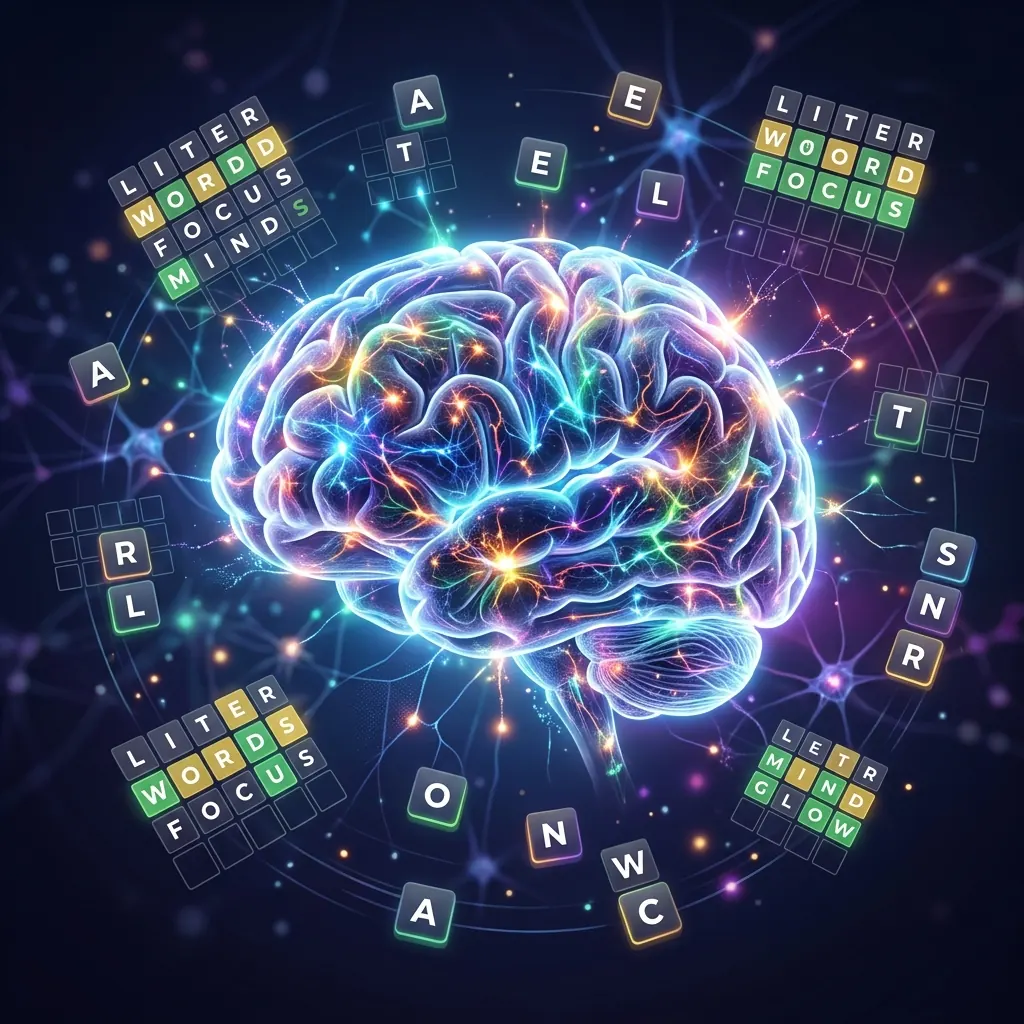
When you stare at those five empty boxes and type your first guess, your brain activates a remarkable chain of cognitive processes:
- Lexical access — Your temporal lobe searches through your mental dictionary of ~20,000-35,000 words
- Pattern recognition — Your visual cortex processes the green/yellow/gray feedback
- Working memory — Your prefrontal cortex holds eliminated letters while generating new candidates
- Logical reasoning — You apply deductive logic to narrow down possibilities
- Decision making — You evaluate risk/reward between "safe" and "risky" guesses
All of this happens in seconds, across multiple brain regions simultaneously. That's not "just a game" — it's a full neurological workout.
1. Strengthens Working Memory
Working memory — your brain's ability to hold and manipulate information temporarily — is arguably the most exercised cognitive skill during Wordle. You're simultaneously tracking which letters are confirmed, eliminated, and repositioned while generating candidate words.
A 2023 study published in the Journal of Cognitive Enhancement found that participants who engaged in daily word puzzle activities for 8 weeks showed a 14% improvement in working memory tasks compared to a control group that played no puzzles.
2. Expands Your Vocabulary (Without Trying)
Every Wordle player knows the feeling: the answer is a word you vaguely recognize but never use. FJORD. KNOLL. SIEGE. Each game passively reinforces word knowledge and occasionally introduces entirely new vocabulary.
Research from the University of Nottingham shows that encountering words in puzzle contexts leads to stronger retention than reading them in text, because the puzzle format forces active retrieval rather than passive recognition.
3. Improves Pattern Recognition
Experienced Wordle players develop an almost intuitive sense for common letter patterns. You start to "feel" that a word ending in "—IGHT" or "—OUND" is likely before you consciously process why.
This is your brain building pattern recognition circuits — the same neural pathways used in:
- Reading comprehension and speed
- Mathematical reasoning
- Musical pattern detection
- Social cue interpretation
4. Exercises Deductive Reasoning
Wordle is, at its core, a logic puzzle. Each guess provides constraints that narrow your solution space — a process identical to deductive reasoning in science, law, and engineering.
When you think "I know there's an A but not in position 2, and there's no S, T, or E," you're practicing formal logical deduction. A 2024 meta-analysis of 47 studies found that regular engagement with logic-based puzzles was associated with measurable improvements in analytical reasoning across age groups.
5. Reduces Stress (The Good Kind of Challenge)
This might sound counterintuitive — aren't puzzles stressful? Not in the way that harms you. Wordle provides what psychologists call "eustress" — positive stress that promotes growth and engagement.
The game hits the sweet spot of challenge: hard enough to be engaging, achievable enough to avoid frustration. This creates a flow state, which research consistently links to reduced anxiety and improved mood.
"Flow activities like word puzzles activate the brain's reward circuits while simultaneously reducing activity in the amygdala, the brain's fear and anxiety center."
— Dr. Mihaly Csikszentmihalyi, Flow: The Psychology of Optimal Experience
6. Builds Daily Mental Discipline
One underappreciated benefit of Wordle is its daily format. Like brushing your teeth or exercising, solving a puzzle every morning creates a cognitive routine — a predictable time when your brain is actively challenged.
Research on habit stacking shows that anchoring a mental challenge to an existing daily routine (coffee + Wordle, for example) creates sustainable cognitive engagement that single-session brain training can't match.
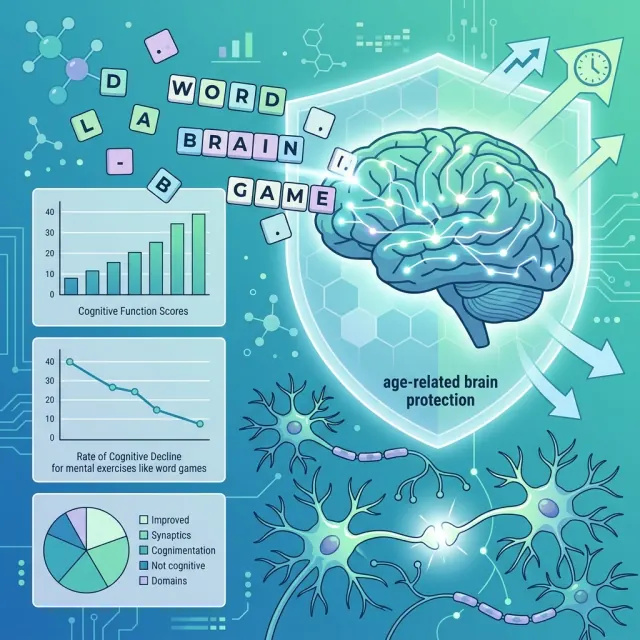
7. May Slow Cognitive Decline
Perhaps the most compelling evidence: a large-scale 2023 study of 11,000+ adults aged 50-93 found that those who engaged in daily word puzzles had cognitive function equivalent to people 8-10 years younger than those who didn't.
The researchers were careful to note that this is a correlation, not definitive proof of causation. But the association was strong enough that the Alzheimer's Research UK organization now recommends word puzzles as part of a brain-healthy lifestyle.
How to Maximize the Brain Benefits
- Play daily — Consistency matters more than intensity
- Don't use answer lookup sites — The struggle IS the workout
- Try different variants — Timer mode and competitive modes add cognitive pressure
- Play before screen time — Start your brain day with an active challenge
- Discuss with friends — Social engagement adds another cognitive layer
Give Your Brain a Daily Workout
Play unlimited Wordle puzzles with timer mode for added challenge.
Start a Brain Workout