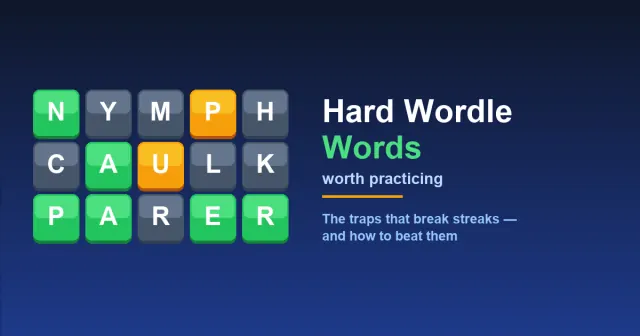
It's guess 5. You know four of the five letters. You've tried every word you can think of. Nothing works. And then the awful realization dawns: one of the letters appears twice.
This scenario has ended more Wordle streaks than any single word pattern. Double letters are the silent killers of the Wordle world — invisible until they blindside you.
How Common Are Double Letters?
More common than most players think:
| Pattern | % of Wordle Answers | Examples |
|---|---|---|
| 5 unique letters | ~72% | CRANE, SLATE, MUSIC |
| One pair (double letter) | ~25% | STEEL, HAPPY, TEETH |
| Two pairs | ~2.5% | GEESE, EERIE |
| Triple letter | ~0.5% | Extremely rare in answers |
That means roughly 1 in 4 Wordle answers has a repeated letter. If you play daily, you'll encounter doubles about 7-8 times per month. That's frequent enough to need a strategy.
The Four Types of Doubles
Type 1: Adjacent Doubles (Most Common)
Two identical letters side by side. These are the easiest to spot because they form recognizable patterns:
- -LL: SPELL, SKULL, DWELL, KNOLL, SWELL, STALL
- -SS: GROSS, BLISS, CLASS, DRESS, FLOSS, PRESS
- -EE: GREED, FLEET, SWEEP, STEEL, CREEP, WHEEL
- -OO: BLOOM, TROOP, PROOF, DROOL, SCOOP, FLOOD
- -FF: BLUFF, CLIFF, SCOFF, STAFF, STUFF, SNIFF
- -TT: LATTE, MOTTO, KITTY, WITTY, RATTY, NUTTY
Type 2: Split Doubles (Trickier)
The repeated letter appears in two non-adjacent positions. Harder to detect:
- E..E: ERASE, EVADE, EDGES, SCENE, DENSE (E at positions 1+5 or 1+3)
- A..A: ARENA, PANDA, LLAMA, SALAD, MANGA
- R..R: RADAR, RULER, RIVER, RIPER, ERROR
Type 3: Double + Different Position
These have a "visible" repeated letter pattern that can mislead:
- TEETH — two E's AND two T's
- GEESE — three E's (!)
- EERIE — three E's again
Type 4: The Vowel Double
Doubled vowels are particularly tricky because vowel-testing strategies often assume each vowel appears at most once:
ABBEY (two B's but also — wait, that's a consonant double with vowels around it), GOOSE, MOOSE, LOOSE — double O words are the most common vowel doubles.
When to Suspect Doubles: The 3-Signal System
Signal 1: You've confirmed 3-4 unique letters but nothing fits. If you know the word contains R, A, E, and T but no 5-letter word with unique letters matches your position constraints, a double is likely.
Signal 2: The gray tiles don't make sense. If you tested the letter E and got yellow, then tested it again in another position and got gray — the answer has E, but only one of them. This confirms no double E.
Signal 3: You're on guess 4+ and stuck. By guess 4, most unique-letter words have been narrowed to 1-3 candidates. If none of them fit your constraints, start considering doubles.
Strategy for Handling Doubles
In Normal Mode
If you suspect a double by guess 3-4, use a "double-testing" guess. For example, if you know E is in the word and suspect a double, try a word with two E's (STEEL, CREEK, TEETH) to test the theory.
In Hard Mode
Hard Mode makes doubles even more dangerous because you can't use throwaway guesses. If you suspect a double, your next guess must incorporate it while also matching all existing constraints. This is where practice really pays off — the more double-letter words you've encountered, the faster you'll find candidates.
The Most Common Doubles (Memorize These)
These are the doubled letters that appear most frequently in Wordle answers, in order:
- L — appears doubled most often (SPELL, DWELL, SKULL...)
- S — second most common (GRASS, BLISS, CROSS...)
- E — third (GREED, STEEL, CREEK...)
- O — fourth (BLOOM, PROOF, DROOL...)
- T — fifth (LATTE, MOTTO, KITTY...)
Together, these five letters account for about 80% of all doubles in Wordle. When you suspect a double, check L, S, and E first.