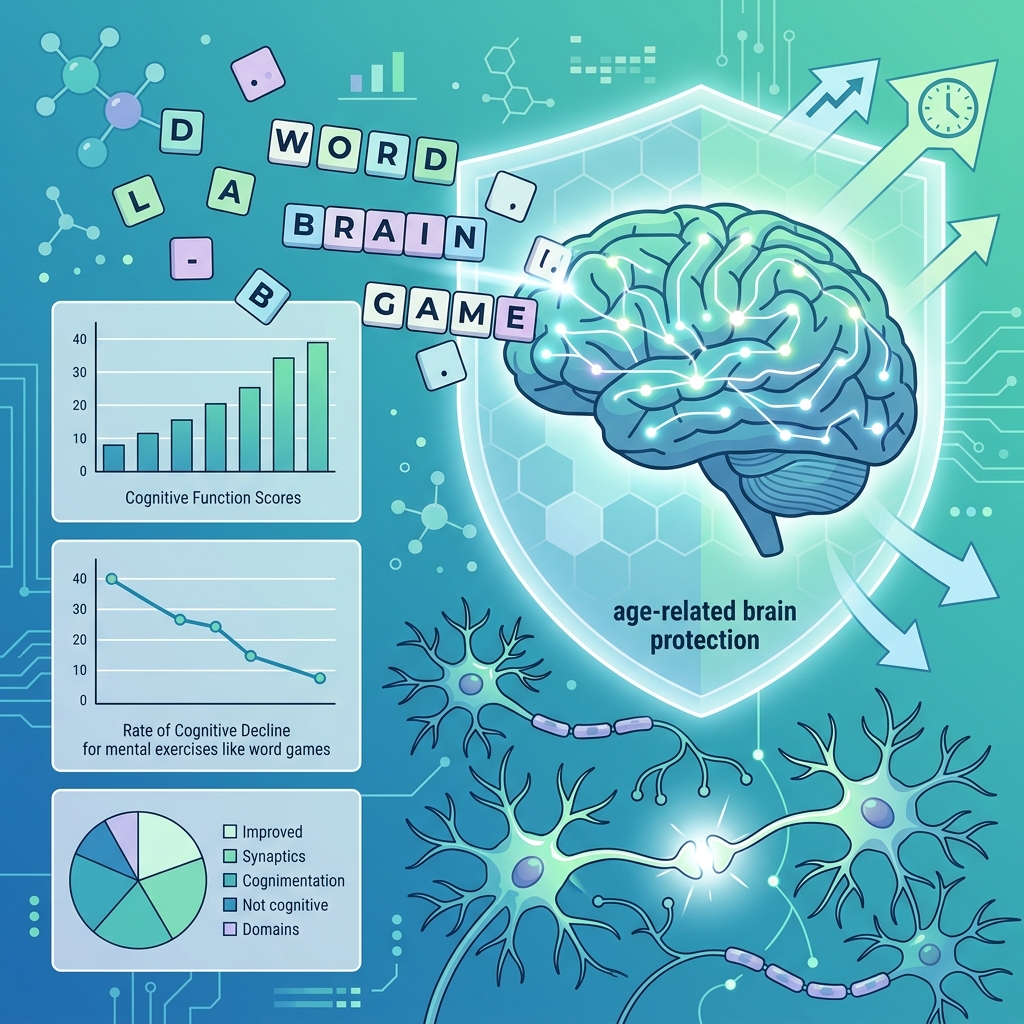
You've seen the headlines: "Word Puzzles Prevent Alzheimer's!" "Daily Brain Games Keep Dementia at Bay!" "Wordle Might Save Your Brain!" These headlines are well-intentioned but misleading. The actual research is more nuanced — and in some ways, more interesting — than the clickbait suggests.
Let's look at what peer-reviewed studies actually say about word games and cognitive aging.
The Cognitive Reserve Theory
The most well-supported framework connecting puzzles to brain health is cognitive reserve theory. The concept: people who engage in more mentally stimulating activities throughout life build a larger "reserve" of neural connections. This reserve doesn't prevent brain disease, but it provides backup pathways when disease occurs.
Think of it like a highway system. A city with many roads (high cognitive reserve) handles road closures better than a city with few roads (low cognitive reserve). The closures still happen — but the impact is less severe.
Key Studies
The PROTECT Study (2019-2023)
The most directly relevant research: University of Exeter's PROTECT study followed 19,000 participants aged 50+ over several years. Findings:
- Participants who regularly did word puzzles scored equivalently to people 10 years younger on cognitive assessments
- The benefit was strongest for grammatical reasoning and short-term memory
- Benefits were dose-dependent: more frequent puzzle engagement correlated with better scores
Important caveat: This is correlational data. It doesn't prove puzzles CAUSED better cognition. It's possible that people with better cognition are simply more likely to do puzzles.
The Rush Memory and Aging Project
Following 1,200+ older adults for up to 21 years, this study found that participants with high cognitive activity levels experienced 32% slower cognitive decline compared to those with average activity levels. Word puzzles were among the activities counted.
The ACTIVE Trial
The largest randomized controlled trial of cognitive training: 2,832 adults aged 65-94. While the training tested wasn't specifically word puzzles, the trial demonstrated that targeted cognitive exercises can produce measurable improvements that last up to 10 years.
What This Means for Wordle Players
What the Evidence Supports:
- Regular cognitive engagement (including word puzzles) is associated with better cognitive function in older age
- The benefits are real and measurable, even if the mechanism isn't fully understood
- Consistency matters more than intensity — daily light engagement outperforms occasional heavy engagement
- Word puzzles specifically strengthen verbal fluency, working memory, and reasoning speed
What the Evidence Does NOT Support:
- Puzzles prevent Alzheimer's disease or other dementias
- Puzzles reverse existing cognitive decline
- Any single game is superior to others for brain health
- Brain games can replace exercise, social connection, or sleep for cognitive health
A Balanced Approach to Brain Health
Wordle is part of a healthy cognitive lifestyle — but it's not the whole picture. The research-backed formula for cognitive longevity:
- Physical exercise — The single strongest protector against cognitive decline
- Social connection — Regular meaningful social interaction
- Quality sleep — 7-8 hours for most adults
- Mental stimulation — This is where Wordle fits. Daily cognitive challenges maintain neural pathways.
- Diet — Mediterranean-style diets show cognitive benefits
Wordle handles item #4 beautifully. Five minutes per day of genuine cognitive engagement, built into a sustainable daily habit. It's not a miracle cure — it's one piece of a healthy cognitive lifestyle.
Add Wordle to Your Brain Health Routine
Five minutes of daily cognitive exercise — backed by research.
Play Daily