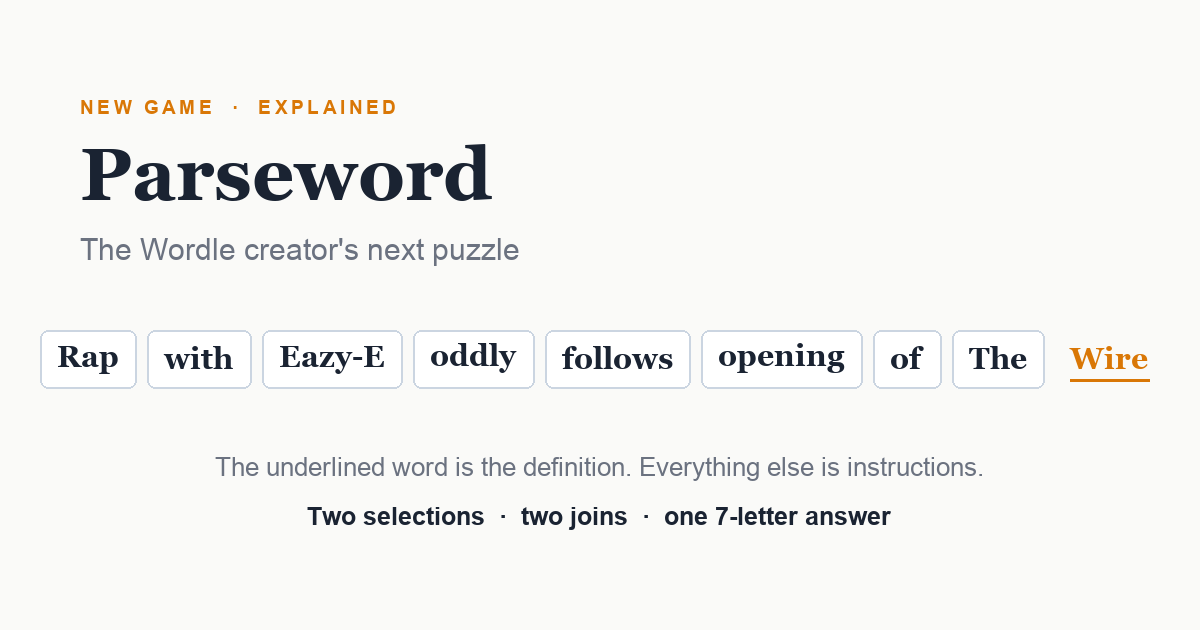
The man who made Wordle has made another game. It came out on 10 March 2026, it is called Parseword, and most Wordle players still have not heard of it.
Josh Wardle built Wordle for one person and then watched it become everyone's morning ritual before selling it to the New York Times. Parseword is the follow-up, and by his own account it is the one he wanted to make on purpose: "Releasing Parseword is happening more on my own terms, instead of happening to me." The idea came from hearing screenwriter Craig Mazin explain cryptic crosswords on a podcast - Wardle got interested, then got obsessed, then tried to make the form less forbidding.
We sat down with the live puzzle to work out what it actually is. Here is the honest version.
What Parseword actually is
It is one daily cryptic puzzle, numbered, free, in the browser. On 27 September 2026 it was puzzle #242, the clue was credited to Chris Kohler, and the game labelled it HARD in a little red badge before we had typed anything.
That last detail matters more than it sounds. Parseword tells you up front how hard the day is going to be. Wordle never does.
The clue that day read:
Rap with Eazy-E oddly follows opening of The Wire
Every word except the last sits in its own little box you can click. Wire is underlined, and that underline is the whole key: it is the definition. The answer means "wire". Everything else in the clue is instructions for building it.
How a clue actually works
You do not type an answer. You dismantle the clue. The loop is three steps, and the game states them on screen:
| Step | What you do |
|---|---|
| 1. Select | Click one or more words from the clue |
| 2. Choose | Pick an option that replaces what you selected |
| 3. Repeat | Keep going until the pieces spell the solution |
So "opening of The" is not decoration - it is an instruction meaning take the first letter of "The". "Oddly" means take the odd-numbered letters. The transforms have names: selections and joins are the two this puzzle used, and the full set includes anagrams, containers, deletions and reversals.
Crucially, the game shows its working. A Learn mode panel told us, before we started: "This puzzle uses two selections and two join transforms. The definition is wire. Transform the rest of the clue into 1 word with 7 letters."
That is the accessibility trick, and it is a good one. A newspaper cryptic hands you a sentence and wishes you luck. Parseword tells you how many moves it takes and how long the answer is. You are still doing the hard part, but you are not guessing at the shape of the problem.
Wire, and you know because it is underlined. In a printed cryptic you have to work out which end of the clue is the definition yourself, and that alone defeats most beginners. Parseword just tells you. The rest of the clue is machinery.
How it compares to Wordle
| Wordle | Parseword | |
|---|---|---|
| What you do | Guess five-letter words | Dismantle a clue into parts |
| Skill it tests | Vocabulary and deduction | Wordplay and lateral thinking |
| Time per puzzle | 2-5 minutes | Often much longer |
| Difficulty shown | No | Yes - badge before you start |
| Puzzles per day | One | One |
| Cost | Free on NYT, with limits | Free |
The honest summary: Wordle is a five-minute check on whether your brain is awake. Parseword is a sit-down. If you have ever found Wordle too easy - and if you have read our breakdown of whether Wordle is getting harder, you know the ceiling is lower than people think - Parseword is the step up.
No, but it helps a lot. The game ships a tutorial, a set of Starter Puzzles and a "Parseword 101" video series precisely because the learning curve is real. Expect your first few days to be slow.
Is Parseword free?
Yes. The daily puzzle needs no account and no payment, and there is no app to download - it runs in any browser at parseword.com. There is a Sign In button, but the site is explicit about what it is for: "Sign in to sync your stats across multiple devices." That is it. Skip it and nothing is locked.
Who should actually play it
Play it if you like the idea of cryptics but bounced off a newspaper one. That is precisely the person Wardle built it for, and the design decisions - underlined definitions, stated transform counts, difficulty badges - all point the same way.
Skip it if what you want from a word game is five minutes and a streak. Parseword rated an ordinary Sunday "HARD". It is not a commute game.
And there is the same catch Wordle has: one puzzle a day. Solve it and you are done until tomorrow. That is deliberate, and for a lot of people it is the wrong amount.
Want more than one puzzle a day?
Unlimited Wordle rounds at three difficulty levels - play as many as you like, no waiting for midnight. No account needed, completely free.
Play Wordle Unlimited - FreeThe short answer
Parseword is the Wordle creator making cryptic crosswords approachable, and it mostly works. It is free, it is genuinely clever, and it is much harder than Wordle. If you want the daily brain-teaser to take longer, it is the best thing to land in years. If you want to actually play word games rather than solve one and stop, you will still need something else - and you can find our picks in the 12 best Wordle alternatives.
Either way, it is worth knowing that the person who started all this is still building. For how the first one happened, see the surprising history of Wordle.
Common questions
Yes. The daily puzzle is free with no account required. Signing in is optional and only syncs your stats across devices.
No. There is no download. It runs in any modern browser at parseword.com, the same way Wordle originally did.
Considerably. Wordle asks you to guess five-letter words; Parseword asks you to decode a cryptic clue using wordplay operations like anagrams, deletions and reversals. It also labels puzzles by difficulty - the 27 September 2026 puzzle was rated HARD.
Yes. Wardle, who created Wordle and sold it to the New York Times in 2022, launched Parseword on 10 March 2026. He has said the idea came from hearing Craig Mazin explain cryptic crosswords on a podcast.