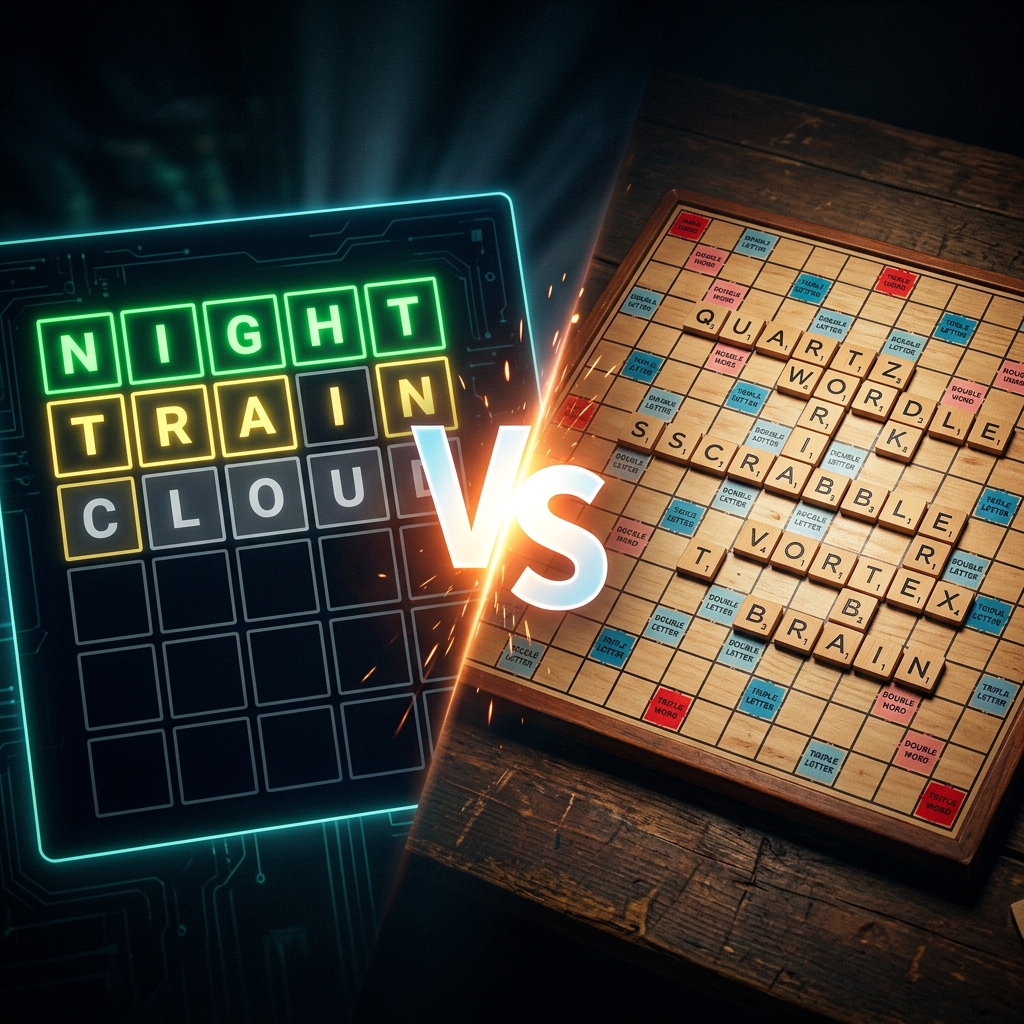
"Games like Scrabble" means four different things depending on who is asking.
Some people want Scrabble's exact rules without waiting for everyone to sit at a table. Some want the tile-and-word feeling without the forty-minute commitment. Some want a genuinely different twist on the same idea. And some just want a short word puzzle to do with a coffee.
Sorting the options that way is more useful than another ranked list, so that is how this is organized.
If you want Scrabble's actual rules, online
Wordfeud
The closest thing to real Scrabble on a phone. Same 15×15 board, same bonus squares, same turn-based rhythm. Its own numbers put it at 40 million players, and it lets you run up to 30 simultaneous games — which is the feature that matters, because it turns Scrabble from an event into something you dip into across the day.
Crucially, there is no time pressure: a move can take you ten seconds or two days. It supports ten languages, including German, French, Spanish, Dutch and the Nordic languages. Free with ads on iOS and Android.
Words With Friends 2
The famous one, and still the biggest by player count. The board differs slightly from Scrabble's — bonus squares sit in different places, so opening theory you learned from Scrabble does not transfer cleanly — and the dictionary is more permissive, which purists dislike and casual players quietly enjoy.
Best reason to pick it over Wordfeud: everyone you know already has it. Worst reason: the app has grown heavy with prompts and bonus modes around a very simple game.
If you want the tiles but not the forty minutes
Bananagrams
The best physical alternative, and the fastest. No board, no scoring, no turns. Everyone races to build their own connected crossword from their own tiles, and when someone runs out, everybody draws again. A game takes about five minutes.
Removing the board is what makes it work. There is no agonising over whether to burn a triple-word square, because there are no squares — only speed. It also travels in a banana-shaped pouch, which is why it lives in so many holiday bags.
Nanagrams
A free, browser-based take on the Bananagrams format. No download and no sign-up — you open it and you are playing. You can go solo, against bots, or live against other people.
Worth knowing about because it fills the specific gap most of this list does not: something Scrabble-adjacent you can play right now on a work laptop without installing anything.
If you want a genuine twist on the idea
Upwords
Scrabble in three dimensions. Tiles stack, so you can play a letter on top of an existing one to change a word — turning CARE into CARD, or BOAT into COAT. The board never fills up, which fixes Scrabble's worst late-game problem, where everyone is stuck holding a Q with nowhere to put it.
Quiddler
Cards rather than tiles, and the hands get progressively longer — three cards in the first round, up to ten in the last. Because you are building whole hands into words rather than hooking onto a shared board, it plays much faster and forgives beginners far more than Scrabble does.
Boggle
The other classic, and the purest test of pattern-spotting. Sixteen dice, three minutes, find every word you can trace through adjacent letters. Where Scrabble rewards vocabulary and board tactics, Boggle rewards speed of recognition — which is a genuinely different skill, and the reason some people who lose at Scrabble routinely win at Boggle.
If what you actually want is five minutes, not an evening
This is worth saying plainly, because a lot of people searching for Scrabble alternatives are not looking for another long game. They want the same pleasure — arranging letters until something clicks — in a much smaller container.
That is the Wordle format's whole appeal, and it is a different genre rather than a Scrabble substitute. There is no board, no score, no opponent to wait for. One five-letter word, six guesses, done.
WordlyPlay is our take on it, and the reason it belongs in this particular list is the multiplayer part: two players can race the same word in real time, joined by a room code or matched with a random opponent. That gets you the head-to-head element people actually miss from Scrabble, in about ninety seconds rather than forty minutes. There is also a shared daily puzzle — everyone worldwide gets the same word — and unlimited practice at three difficulty levels.
Fancy a quick word game instead?
Race a friend on the same word in real time, or play the shared daily puzzle - free, no account.
Play Free - No Account NeededWhich one should you pick?
- You want real Scrabble, asynchronously: Wordfeud. The 30-simultaneous-games feature is the difference-maker.
- Your friends are already somewhere: Words With Friends 2. Network effects beat rule purity.
- You have people in the room: Bananagrams. Five minutes, no scoring arguments.
- You want to play right now, in a browser: Nanagrams.
- Scrabble's endgame frustrates you: Upwords. Stacking removes the dead board entirely.
- You lose at Scrabble but spot words fast: Boggle.
- You have five minutes, not an evening: a Wordle-style daily.
One honest caveat
Nothing on this list replaces Scrabble if what you love about Scrabble is the board itself — the hoarding of an S, the fight over a triple-word square, the long game of denying someone the bottom-right corner. Wordfeud is the only entry that genuinely preserves that, and it does so by being almost the same game.
Everything else here is better understood as a different answer to the same question: what is the most enjoyable way to arrange letters against another person? Scrabble's answer takes forty minutes. Some of these take ninety seconds. Both are valid, and which one is right depends entirely on how much of an evening you actually have.