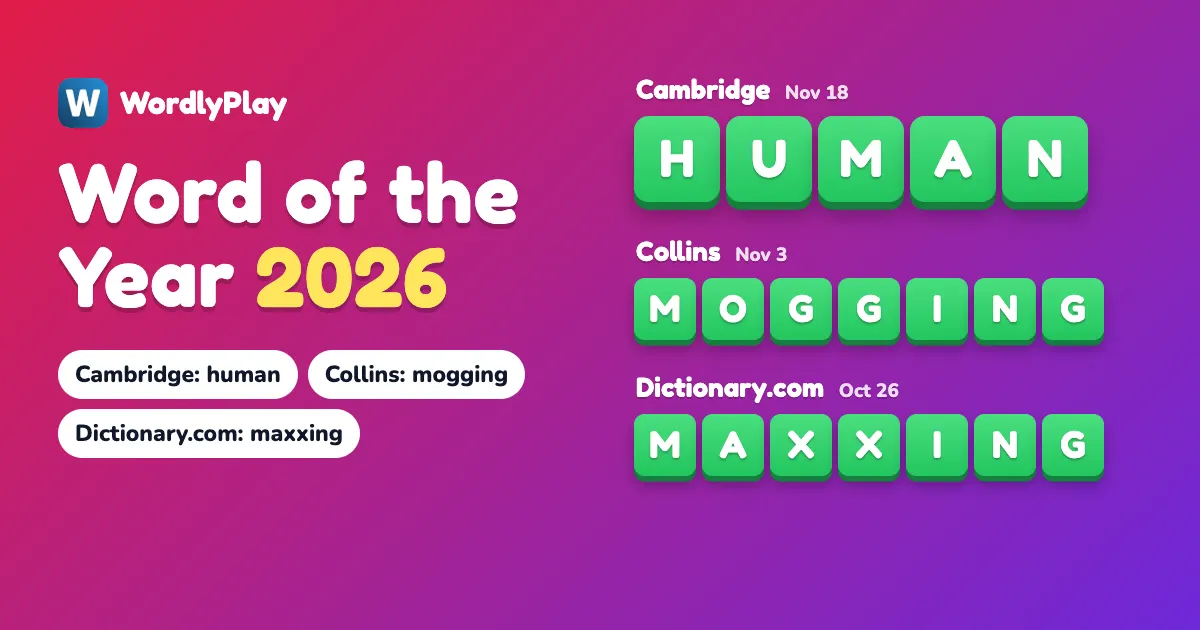
Three dictionaries have named their 2026 Word of the Year so far: Cambridge Dictionary picked human, Collins picked mogging, and Dictionary.com picked maxxing. Oxford and Merriam-Webster have not announced yet. This page is up to date as of November 19, 2026, and we will add their picks when they arrive.
Two stories run through this year's choices. One is artificial intelligence and what it means for people. The other is online slang moving from group chats into everyday speech. Here is what each word means, why it won, and which words came close.
What is the 2026 Word of the Year?
There is no single Word of the Year. Each dictionary chooses its own, using its own data. These are the 2026 picks announced so far:
| Dictionary | Word | Meaning |
|---|---|---|
| Cambridge | human | Being a person, not a machine |
| Collins | mogging | Outshining someone |
| Dictionary.com | maxxing | Doing something to the max |
| Oxford | Not yet | |
| Merriam-Webster | Not yet |
Why did Cambridge choose "human"?
Cambridge announced human on November 18, 2026, because AI changed how people talk about being human this year. As AI tools write, draw and make decisions, people started asking which skills they want to keep for themselves. Cambridge's lexicographers pointed to worries about handing too much thinking over to machines, and to a fresh appreciation for human creativity and connection.
Cambridge also named other contenders:
- agent: an AI system that can make decisions and act without a person in control.
- analogue: things and experiences that don't involve the internet or digital technology.
- wholesome: likely to make your life better, physically, morally or emotionally. It was the one contender with nothing to do with technology.
No. A Word of the Year doesn't have to be new. It is the word that best sums up the year, based on what people looked up, searched for and talked about. Cambridge picked an old, everyday word because the way people use it changed.
What does "mogging" mean?
Mogging means outshining someone or something. Collins named it on November 3, 2026, and says people use it in a playful, ironic way when someone gets upstaged, for example when a friend turns up in a better outfit, or a new phone makes the old one look tired. The slang has been around online since the 2010s, but Collins says Gen Z and Gen Alpha have now firmly adopted it, and its use rose about 210% in 2026.
Collins' shortlist shows how much of the year's language came from online culture and the cost of living:
| Shortlisted word | Meaning |
|---|---|
| bixie | A haircut between a bob and a pixie cut |
| carspreading | Cars getting ever bigger, wider and heavier |
| firewave | A run of wildfires reaching towns and cities |
| fricy | Food or drink that is both fruity and spicy |
| friendslop | Cheap, simple video games played with friends |
| ghost job | A job ad posted with no plan to hire anyone |
| P(doom) | The estimated chance that AI leads to disaster for civilization |
What does "maxxing" mean?
Maxxing is short for maximizing. It means doing something to the fullest, and it often goes on the end of another word, as in sleepmaxxing or tokenmaxxing. Dictionary.com named it on October 26, 2026, because it showed up everywhere this year, across many topics, and because it captures a very online habit of optimizing everything. The dictionary says use of one form, looksmaxxing, rose more than 1,000% in the media it studied this year.
Dictionary.com's other finalists were:
- affordability: how cheap or expensive things are, from housing to groceries and childcare.
- data center: a building that processes and stores huge amounts of computer data.
- unc: short for "uncle", slang for an older person who is out of touch or trying too hard.
- odyssey: a long, eventful journey, a word that got a boost from Christopher Nolan's 2026 film.
Make a Word of the Year game
Put human, agent, mogging and maxxing into one room and see who solves them fastest. Friends join with a code, no app needed.
Create a Wordle RoomWhen will Oxford and Merriam-Webster announce?
As of November 19, 2026, neither Oxford nor Merriam-Webster has named a 2026 word. Both usually announce later in the season, toward the end of the year. We will update this page when they do.
For comparison, last year Collins chose vibe coding, Merriam-Webster chose slop, and Dictionary.com chose 6-7.
How do dictionaries choose a Word of the Year?
Each dictionary looks at its own evidence and then its editors decide. That evidence includes which words people searched for and looked up, how often a word appeared in news articles and on social media, and whether its meaning shifted during the year. That is why the lists differ so much: each dictionary weighs different data, and its editors make the final call.
Not because it won. Many winners, like human, have been in dictionaries for centuries. Newer slang gets added when editors see it used widely enough.
What do the 2026 words say about the year?
Put together, the picks describe a year when technology was on everyone's mind. Most of Cambridge's contenders are about AI or stepping away from screens, and the winner was the word for us: human. At the same time, slang from gaming and social media, like mogging, maxxing and unc, became normal enough that dictionaries now treat it as everyday English.
Money worries show up too. Affordability made Dictionary.com's final list, and ghost job made Collins' shortlist.
Can you play the 2026 words as a word game?
Yes. Human and agent are both 5 letters, so they work as a classic Wordle-style puzzle, while mogging, maxxing and odyssey are 7 letters. Here is how to make a Word of the Year round for friends, family or a class:
- Open a Wordle Room and choose "your own words". The host needs a free account, and your first hosted game is free.
- Type the words. Each word needs 4 to 7 letters, so human, agent, mogging, maxxing, odyssey, bixie and fricy all fit, while analogue, wholesome and unc don't. You can add a short clue to each word.
- Share the code. Players go to wordlyplay.com/join, type the code and a name. No account or download needed.
- Play. Each word is played at its own length. Slang that isn't in the regular dictionary still counts when someone guesses it exactly.
Teachers can apply for a free classroom and run the same game with a whole class, which makes a quick lesson on how language changes. For solo practice with longer words, try 7-letter Wordle.
Practice with unlimited words
No daily limit: play as many 5-letter puzzles as you like, free.
Play Wordle UnlimitedFrequently asked questions
So far, three dictionaries have chosen: Cambridge Dictionary picked human, Collins picked mogging and Dictionary.com picked maxxing. Oxford and Merriam-Webster had not announced as of November 19, 2026.
Human. Cambridge announced it on November 18, 2026, saying AI changed how people think and talk about being human. Agent, analogue and wholesome were among the other contenders.
Mogging means outshining someone or something. Collins, which made it its 2026 Word of the Year, says it is usually used in a playful, ironic way when someone is upstaged.
Maxxing is short for maximizing: doing something to the fullest or optimizing it. It is often added to other words, as in sleepmaxxing. Dictionary.com named it its 2026 Word of the Year.
Not as of November 19, 2026. Oxford and Merriam-Webster usually announce later in the year. This page will be updated when they do.
Cambridge's word, human, has 5 letters, and so does the runner-up agent. Mogging and maxxing have 7 letters. You can play all of them in a Wordle Room with your own words.