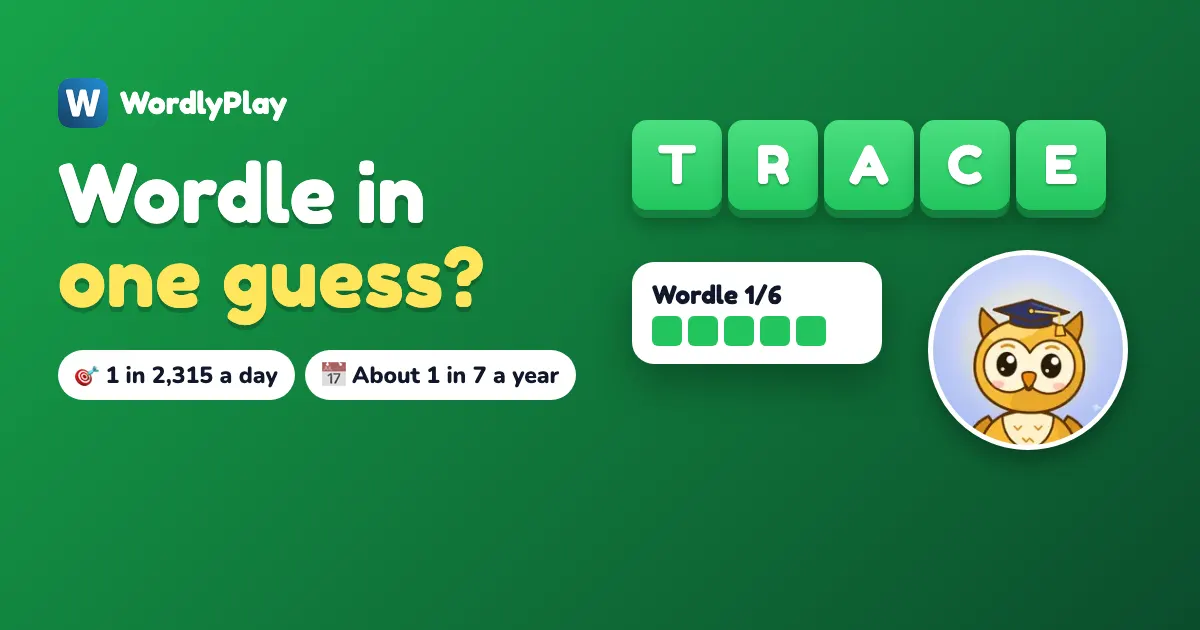
Yes, you can get Wordle in one guess, but it is almost pure luck. If your first word is one that can be an answer, your chance on any single day is about 1 in 2,300, or 0.04%. Open with the same word every day for a year and you have roughly a 1 in 7 chance of hitting it once. Some of the most popular starting words, such as SALET and ROATE, can never be the answer, so with those your chance is zero.
Looking for the New York Times bonus puzzle called Wordle in 1? That is a different game, where you get one scored row and must name the answer. Our Wordle in 1 guide explains it, with five practice rounds.
What are the odds of getting Wordle in one?
Wordle launched with a fixed list of 2,315 possible answers. The New York Times has added a few dozen since and no longer publishes the list, so 2,315 is the best public figure to work with. If your first guess is on that list, it has the same 1 in 2,315 chance as any other answer word of being today's word.
Play every day and the small daily chance adds up:
| Playing for | Chance of one or more | Odds |
|---|---|---|
| 1 day | 0.04% | 1 in 2,315 |
| 30 days | 1.3% | 1 in 78 |
| 1 year | 14.6% | 1 in 7 |
| 3 years | 37.7% | about 1 in 3 |
| 10 years | 79.3% | about 4 in 5 |
These figures assume your opening word is on the answer list and that each answer is equally likely on any day. Nobody outside the Times knows exactly how its editor picks words, so treat them as a good estimate, not a promise.
On two particular days, such as two days in a row, it is about 1 in 5.4 million (2,315 times 2,315). Getting it twice at any point in the same year is far more likely, about 1 in 90, because there are so many pairs of days it could happen on.
Does your starting word change your chances?
Only in one way: your first word has to be a word that can be the answer. Beyond that, every answer word has the same chance. Many of the starters that solvers rate highest were chosen because they split the list well, not because they can win, and several of them are not answer words at all.
| Starting word | Can it be the answer? | Chance of a Wordle in one each day |
|---|---|---|
| SALET, ROATE, SOARE, TARSE | No, they are valid guesses only | Zero |
| ADIEU | No | Zero |
| CRANE, SLATE, TRACE, STARE, RAISE, AUDIO | Yes | About 1 in 2,315 |
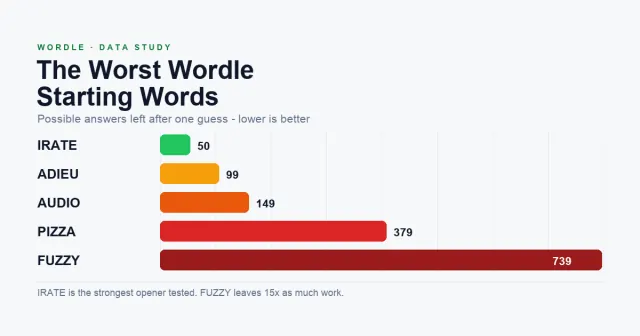
So if a hole in one matters to you, open with a common word that could be an answer. If you care more about solving in as few guesses as possible on average, our look at the best Wordle starting words is the better guide, and the worst starting words explains why ADIEU wastes a guess.
No. If every word you pick is a possible answer, each one has the same 1 in 2,315 chance on the day. Switching words does not raise your odds, and keeping one starter makes your later guesses easier to plan.
Does Wordle repeating words change the odds?
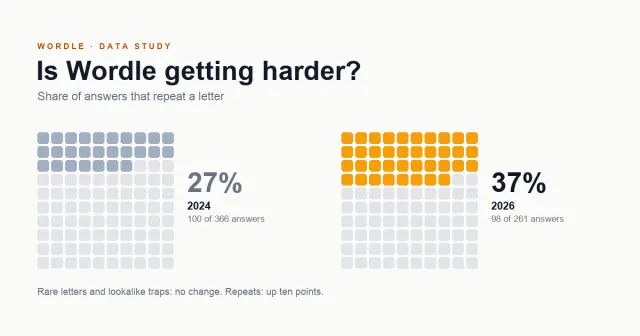
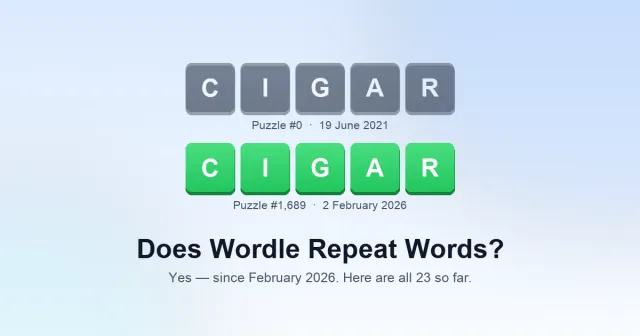
Yes, and for the better. For the first four and a half years, every Wordle answer was used once and never again. If your favourite starter came up as an answer, it could never win you a hole in one after that. TRACE was the answer on 15 December 2021, and for more than four years anyone opening with TRACE had no chance at all.
That changed on 2 February 2026, when the Times began bringing old answers back. TRACE returned on 21 August 2026, so anyone who opened with it that morning got Wordle in one. Now that answers can come back, no starter is ever ruled out for good, and the daily chance stays close to 1 in 2,315 instead of shrinking. Our list of every Wordle repeat so far has the full record.
How many people get Wordle in one?
About 1 game in 250, which is far more than luck alone would give. When the New York Times analysed a year of WordleBot data, 515 million games up to late 2023, about 1 game in 250 was solved on the first guess, roughly 0.4% (the analysis, republished by the NZ Herald). Chance alone would give about 0.04%, so first-guess wins happen roughly ten times more often than the odds say they should.
An earlier study by James Dilger, who used Wordle's public statistics from May to August 2023, found the same pattern: 0.2% to 0.5% of players solving it in one each day. He concluded that thousands of players a day were getting the answer before they played (the study on arXiv).
It does happen to real people every day. Plenty of players post their 1/6 grid, and a TechRadar writer described getting Wordle in one and wishing they hadn't, because a game that ends on the first row has no puzzle left in it.
Is getting Wordle in one cheating?
Not by itself. With millions of people playing, luck alone produces first-guess wins every day. If a million players each opened with a different answer word, about 430 of them would solve it on the first row by chance.
The numbers above do show that not every 1/6 is luck. The Times suggested a few reasons: some players open a new window to try again after failing in six, some have the answer spoiled, and some look it up. It also said not every case is outright cheating, and there is no way to tell from a single grid.
The Times' WordleBot scores your skill and your luck separately, and a first-guess win counts as luck. That is why most players treat a 1/6 as a funny moment, not a skill. If you saw the answer by accident, on a news site or in a group chat, the honest thing is to say so when you share your grid.
Want another shot at a hole in one?
Each game of Wordle Unlimited is a fresh word, so every round is another chance. Free, no account, no daily limit.
Play Wordle UnlimitedHow much more common is Wordle in two?
Much more common, because your second guess uses what the first row told you. We checked every word on our own 2,459-word answer list. With a strong opener such as TRACE, SLATE or CRANE, picking any word that still fits after the first row solves it in two about once in every 17 games. That is roughly 140 times more often than a Wordle in one.
| First word | Words left after it, on average | Chance of solving in two |
|---|---|---|
| TRACE | 82 | About 1 in 16 |
| SLATE | 80 | About 1 in 17 |
| CRANE | 87 | About 1 in 17 |
| ADIEU | 131 | About 1 in 30 |
| AUDIO | 189 | About 1 in 26 |
Vowel-heavy openers like ADIEU and AUDIO leave many more words standing, which is why a 2 is rarer with them. Our guide to solving Wordle in 3 guesses or fewer shows how to make the second guess count.
How to get more chances at a Wordle in one
- Open with an answer word. Pick a common five-letter word that could be the answer, not a solver word like SALET.
- Play more games. The daily Wordle gives you one chance a day. Wordle Unlimited lets you play as many words as you like, and each new word is another chance.
- Keep a record. Your guess distribution shows how many games you solved in one, two, three and so on. Our Wordle tracker guide explains how to read it.
- Make it a contest. In a friend duel you and a friend play the same word at the same time, so a lucky first row wins the round on the spot.
Play today's word
One new word a day, with your streak and stats saved. Free and in your browser.
Play the Daily WordleFrequently asked questions
Yes. If your first word happens to be the day's answer, you solve it in one. It is luck, not skill: with an opening word that can be an answer, the chance is about 1 in 2,315 on any given day.
About 1 in 2,315, or 0.04%, on a single day, as long as your first word is one that can be an answer. Over a year of daily play that adds up to roughly a 14.6% chance, about 1 in 7, of doing it at least once.
Very rare. Most daily players go years without one. You would need to play for about four to five years with the same answer-word starter before a Wordle in one became more likely than not.
On two particular days, such as two days in a row, about 1 in 5.4 million. Getting it twice at any point in the same year is about 1 in 90.
Any word that can be an answer has the same chance, about 1 in 2,315 a day. Popular solver starters such as SALET, ROATE, SOARE and TARSE are not answer words, so they can never give you a Wordle in one.
Not by itself. With millions of daily players, some people get it in one by luck every day. It only becomes cheating if you knew the answer first, and the New York Times found first-try wins happen about ten times more often than luck explains, so some players do.
About 1 game in 250, according to a New York Times analysis of 515 million games up to late 2023. That is roughly ten times what chance alone would produce, because some players already know the answer before they play.
Yes, many people. Players regularly share 1/6 grids, and with millions of games played every day, first-guess wins happen daily somewhere in the world.
No. Wordle in 1 is a New York Times bonus puzzle where you are shown one scored row and must name the answer. Getting Wordle in one means your very first guess in the normal game is the answer.