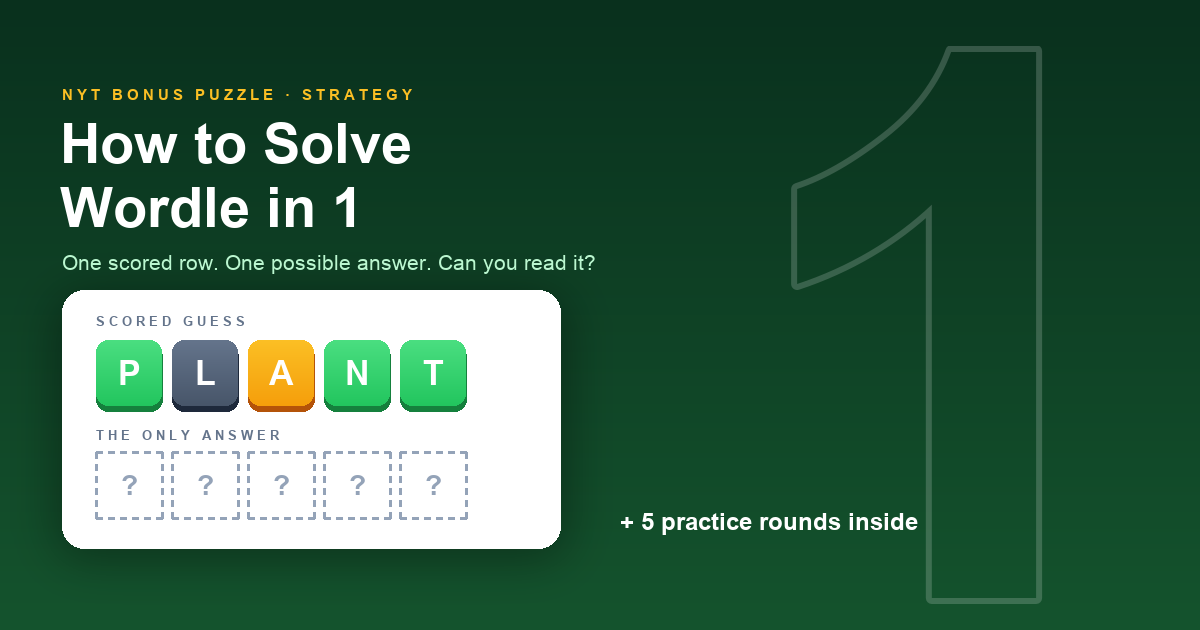
Regular Wordle gives you six tries to find a word. Wordle in 1 gives you one — and a guess someone else has already made.
It launched on 2 September 2026 as part of the New York Times' new bonus puzzles, and it trips up good Wordle players for a specific reason: you can't feel your way to the answer over several guesses. Everything you need is already on the board, in a single scored row. You either read that row properly or you don't.
Below is how the puzzle works, the four rules for reading one row, and five practice rounds with the answers hidden. Try each one before you open it.
How Wordle in 1 works
Each round shows a board with one word already guessed and scored against a hidden answer — greens, yellows and grays, exactly as Wordle would color them. That scoring is chosen so only one possible word fits. You get one attempt to name it.
There are five rounds, and you need all five to win. There's an optional timer if you want the pressure. A new set drops every Wednesday alongside Connections 3×3, Colorful Strands, Mystery Mini and an Easy Mode Crossword.
The first batch was free for everyone. The Times says future weekly releases are for NYT Games and All Access subscribers — we broke down what's still free in Wordle separately.
The four rules for reading one row
1. Count the open squares first. Greens are fixed. Before you think about words, know how many squares are actually left to fill — it's usually fewer than it feels.
2. Every yellow tells you two things. The letter is in the answer, and there's one square it can't use: the one it's sitting in. Most players only use the first half.
3. Gray means gone — with one exception. If the scored word uses a letter twice and one copy comes back gray, that letter can still be in the answer. It just isn't in there twice. Our guide to what Wordle's colors mean covers this in detail.
4. The answer can repeat a letter you've already seen. An open square doesn't have to hold a new letter. This is the rule people forget most often, and round 3 exists to catch you on it.
Five practice rounds
Easy to hard, one technique per round. Work each one out, then tap to reveal the answer and the reasoning.
Round 1 · Warm-up
Green: D, I, O in place · Yellow: A (not first) · Gray: U
RADIO. Three greens leave only squares 1 and 2 open. A has to go in one of them, and its yellow says it isn't square 1 — so it's square 2. That leaves _ADIO, and only one word fits.
Lesson: a yellow with only one legal square left is a green in disguise. Place it before you think about anything else.
Round 2 · The swap
Green: S, A, E in place · Yellow: L (not second), T (not fourth)
STALE. Two open squares, two yellow letters, and each yellow is banned from exactly one of them. L can't go second, so it goes fourth. T can't go fourth, so it goes second. S-T-A-L-E.
Lesson: when the yellows exactly fill the open squares, solve it like a seating plan — each letter takes the one seat it isn't banned from. You never had to think of a word.
Round 3 · The hidden letter
Green: A, E in place · Yellow: S (not first), L (not second) · Gray: T
LEASE. The trap is assuming every open square needs a new letter. Squares 1, 2 and 4 are open, but you only know two letters to fill them. L can't be second and S can't be first, so try L first and S fourth: L_ASE. The missing letter is a second E — and the row couldn't warn you, because SLATE only had one E to score.
Lesson: an unknown square can hold a letter you've already seen.
Round 4 · Forbidden squares
Green: O in the middle · Yellow: C (not first), H (not second), E (not fifth) · Gray: R
EPOCH. Three loose yellows and four open squares, so one letter is still unknown. The strong move is spotting CH — both letters are loose, and it's one of the most common endings in English. Squares 4 and 5 are legal for both. That leaves E and one new letter for squares 1 and 2, and E is allowed first: E_OCH.
Lesson: write down the banned square for each yellow, then look for a common letter pair among them — it usually places two letters at once.
Round 5 · All yellow
Yellow: all five letters — every one is in the word, and not one is in the right place
ASTER, the flower. You need a rearrangement of T, E, A, R, S where every letter moves. Check the familiar ones: STARE keeps A and R in place, RATES keeps S last, TASER and TARES keep T first, RESAT keeps E second. ASTER is the only everyday arrangement that moves all five.
Lesson: an all-yellow row isn't a gift. It rules out every obvious arrangement at once — which is exactly why it's the hardest kind.
What the five rounds teach
| Round | Technique |
|---|---|
| 1 | A yellow with only one legal square is really a green |
| 2 | When yellows exactly fill the gaps, seat each one by elimination |
| 3 | An open square can hold a letter you've already seen |
| 4 | Map each yellow's banned square, then look for a common letter pair |
| 5 | An all-yellow row rules out every familiar arrangement |
None of these need a big vocabulary. Round 2 needs no vocabulary at all. That's the real skill Wordle in 1 tests: not knowing more words, but wasting less of the information you've been given. It's the same habit that makes you better at regular Wordle, where the elimination approach strong players use is built on exactly this kind of row-reading.
Want to sharpen your deduction for free?
Unlimited Wordle at three difficulty levels - every guess trains the same row-reading skill. No account needed, completely free.
Play Wordle Unlimited - FreeCommon questions
A new set of five rounds drops every Wednesday with the rest of the New York Times bonus puzzles.
The first batch was free for everyone. The New York Times says future weekly releases are for NYT Games and All Access subscribers.
There's an optional timer. You can switch it on for extra pressure or play without it.
Regular Wordle gives you six guesses to find an unknown word. Wordle in 1 hands you one guess that's already been scored and asks you to deduce the only word consistent with it — one attempt per round, five rounds in a row.
If one scored row can hide a second E, a normal game can too — our list of double-letter Wordle words is the best place to drill round 3's trap.
All five rounds are original puzzles, not the New York Times'. Each one was checked against all 1,887 words that have ever been a Wordle answer to confirm it has exactly one solution. Game details current to 14 September 2026.